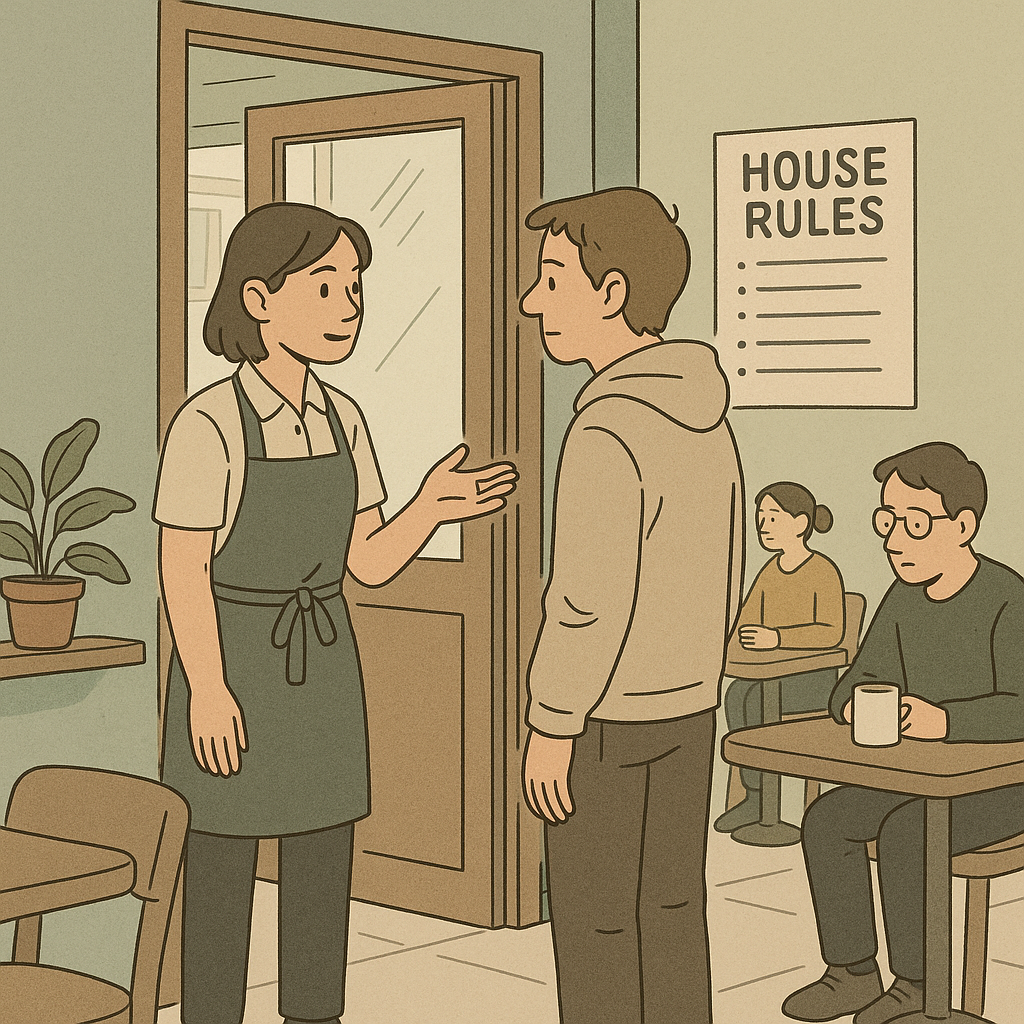
Most of us have had a moment in a store, restaurant, or office lobby where something felt “off”—a disagreement over house rules, a tense conversation at the door, or a question about whether an animal is allowed inside. Businesses do have a “right to refuse service,” but it’s not a blank check. In everyday terms: owners can set reasonable rules to protect staff, customers, and operations—but they can’t use those rules to discriminate.
This matters even more when service and support animals are involved. Many conflicts start with misunderstanding: what staff may ask, what a handler should share, and when a business can legally say “no” (or “not like that—here’s another option”). This guide breaks down the common, lawful reasons a business can deny entry or service, what they must avoid, and how to keep interactions calm and fair.
Private businesses generally can decide how to run their space: they can set rules for behavior, safety, dress, and the flow of service. They can also ask someone to leave if that person creates a real problem.
But the “right to refuse” has a major limit: businesses cannot deny service based on protected characteristics (and in many places, additional protections apply under state or local law). It’s also not enough to have a rule on paper—rules must be enforced consistently. If staff only apply a policy to certain customers, the business can end up facing a discrimination complaint even if the policy itself sounds neutral.
A good way to think about it is this: the strongest, safest refusals are based on observable behavior or neutral rules (what happened), not assumptions about a person (who they are).
Even in a public-facing business, there are clear situations where a manager can legally deny entry or end service. The key is that the reason must be legitimate and non-discriminatory—and the response should be proportionate to the problem.
Common lawful grounds include disruptive or unsafe behavior, interference with operations, and refusing to follow reasonable rules that apply to everyone.
“ "I can’t allow shouting or threats in the store. If it continues, I’ll have to ask you to leave. If you’d like, we can finish your purchase once things are calm." — Example manager script”
What this can look like in real life:
If a customer is yelling at employees, a manager might calmly set a boundary and offer a path forward: “We can help you if we can speak respectfully. Otherwise, we’ll need you to leave for today.”
If a person is intoxicated and stumbling near breakables or other customers, staff may refuse service for safety: “For everyone’s safety, we can’t serve you right now. You’re welcome to come back another time.”
If someone won’t stop blocking a doorway or aisle after multiple requests, staff may end the interaction: “We need to keep this walkway clear. If you can’t step aside, we can’t continue service.”
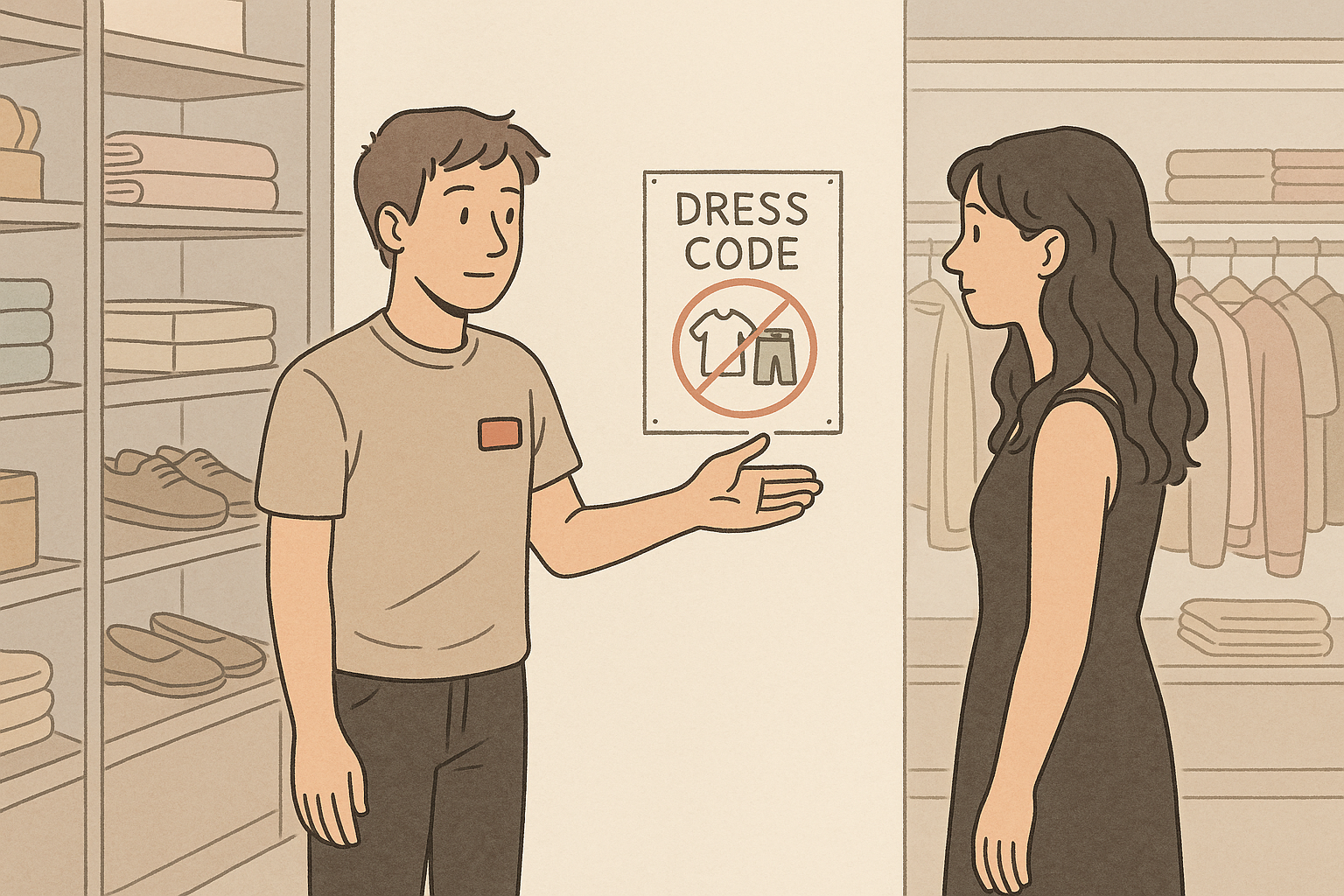
Many “denied entry” situations aren’t dramatic—they’re about everyday policies. Businesses can often enforce neutral rules like dress codes, operating hours, and basic hygiene expectations, as long as they do so evenly.
Examples of common neutral policies:
“No shirt, no shoes, no service.” A business can require footwear or shirts for safety and sanitation reasons.
Arriving after closing. If the doors are locked or service has ended, it’s generally lawful to decline entry. (The safest approach is to enforce closing times consistently and communicate them clearly.)
Hygiene/cleanliness issues. If a customer’s strong odor, soiled clothing, or unsanitary condition is creating a genuine issue for the environment, a business may be able to refuse service—especially in places serving food.
The best protection for both customers and owners is clarity: written policies, visible signage, and staff training that emphasizes even enforcement. When rules are unclear, customers feel singled out, and conflicts escalate.
Businesses can set rules, but changing them mid-conflict can look arbitrary or discriminatory. It’s safer to rely on established, posted policies and apply them consistently.
That can be a red flag. If a policy disproportionately affects certain groups, businesses should make sure the policy is truly necessary and consider reasonable alternatives where required by law.
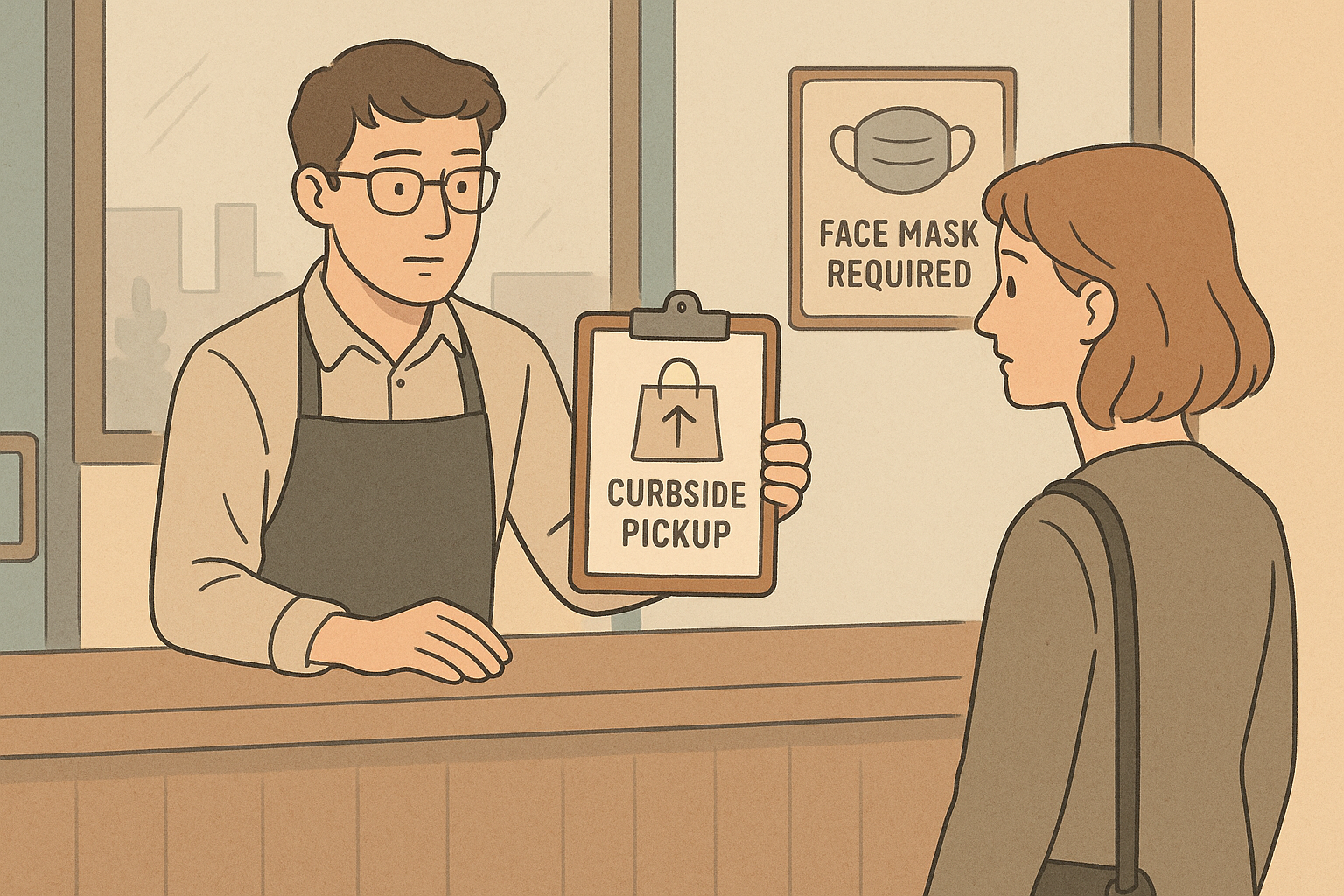
Health-related requirements—like masks, vaccination proof, or other safety steps—often depend on current laws and local rules. When permitted, businesses may enforce these requirements as part of maintaining a safe environment.
However, even when a business has a lawful health policy, it may still need to consider reasonable accommodations for disability-related needs or religious objections where applicable. Accommodation doesn’t always mean “no rule applies.” It often means providing a workable alternative when feasible.
Practical alternatives can include:
Curbside pickup or delivery options.
Remote service (phone, chat, or online ordering).
A designated time or area that reduces close contact.
For customers, it helps to approach these conversations with specifics: “I can’t do X because of Y—what options do you offer instead?” For businesses, it helps to respond with options instead of arguments: “Here’s what we can do today.”
A refusal becomes legally dangerous when it’s based on a protected characteristic—or when it looks like it might be. Under federal law, protected classes commonly include race, color, religion, sex, and national origin (and disability is a major factor in public accommodations). Many state and local laws expand protections to include categories like age, veteran status, pregnancy, medical condition, sexual orientation, gender identity, and more.
Just as important: retaliation can create risk. Refusing service because someone posted a negative review, complained, or simply because staff “don’t like them” can look retaliatory—especially if the business can’t point to a clear, neutral reason like safety or policy violations.
For owners and staff, the safest mindset is to focus on facts and behavior, not feelings. If you can’t explain the decision in a calm sentence that references a neutral rule, pause and involve a manager.
Service animals are a frequent flashpoint—and it’s crucial to separate myths from what’s typically allowed in public-facing businesses.
In general, service animals must be allowed to accompany their handler in areas open to the public. Staff should not treat a service dog like a typical pet policy issue.
That said, the ADA framework still gives businesses a narrow set of circumstances where they can require a service dog to be removed:
If the dog is out of control and the handler does not take effective action to control it.
If the dog is not housebroken.
Importantly, removal of the dog is not the same as kicking out the person. In many situations, businesses should still offer the person the opportunity to get goods or services without the animal present (for example, continuing the purchase or offering an alternative method of service).
What staff may ask is also limited. Many businesses follow the “two questions” concept—asking whether the dog is a service animal required because of a disability, and what work or task the dog has been trained to perform. Staff generally should not demand documentation or ID under the ADA.
Even though documentation is generally not required, clear communication can prevent misunderstandings. For handlers, calmly answering permitted questions (when asked appropriately) can speed up access. For staff, a respectful tone and a focus on behavior (not suspicion) keeps everyone safer.
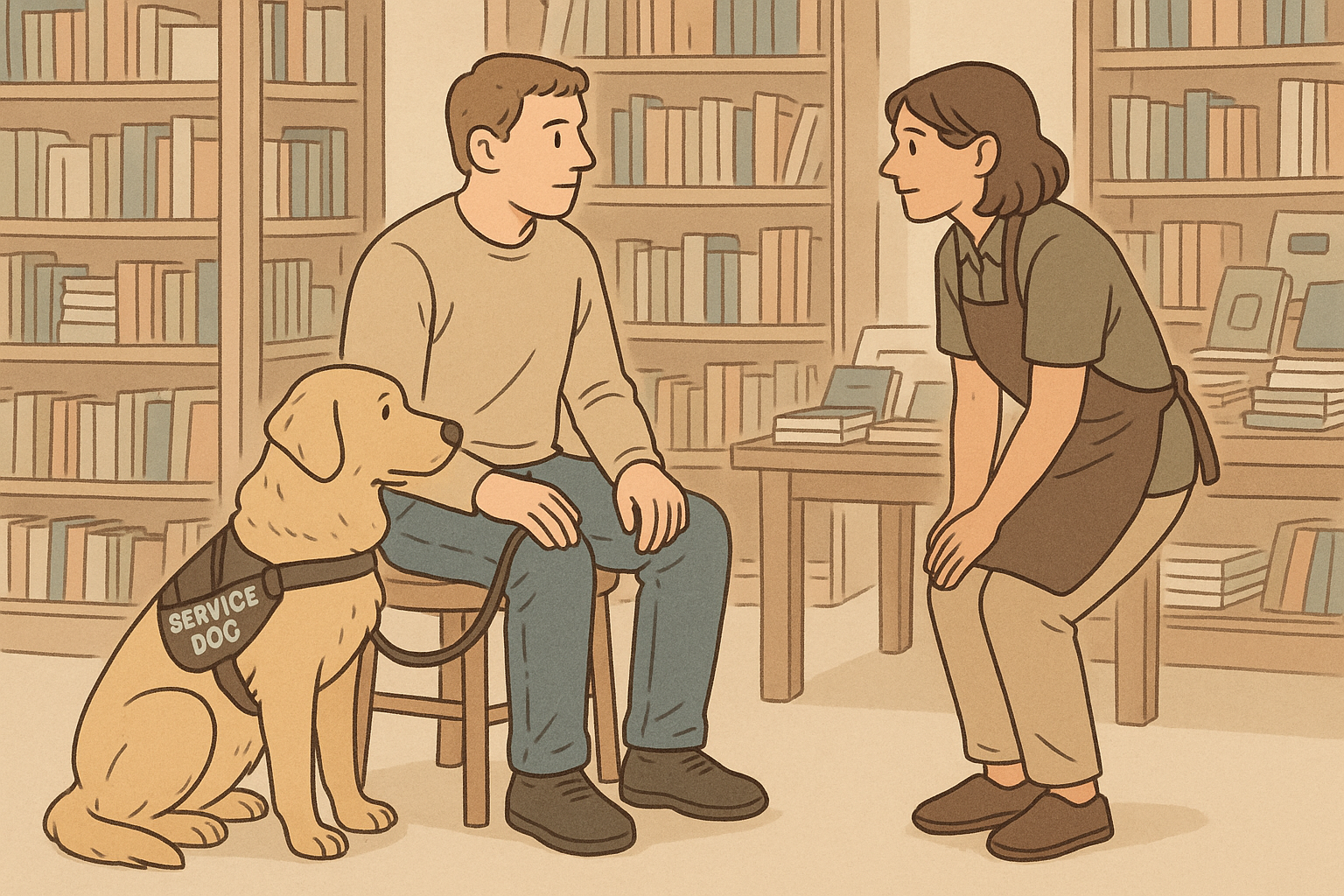
“ "I’m happy to answer the ADA-allowed questions. He’s a service dog, and he’s trained to perform specific tasks that help me manage my disability." — Example handler response”
Fear or allergies don’t automatically override access. Businesses should look for practical solutions (like spacing, moving seating, or faster service) without excluding the handler simply because someone else objects.
A business can require removal if the dog is out of control and the handler doesn’t take effective action, or if the dog is not housebroken. Decisions should be based on behavior observed in the moment.
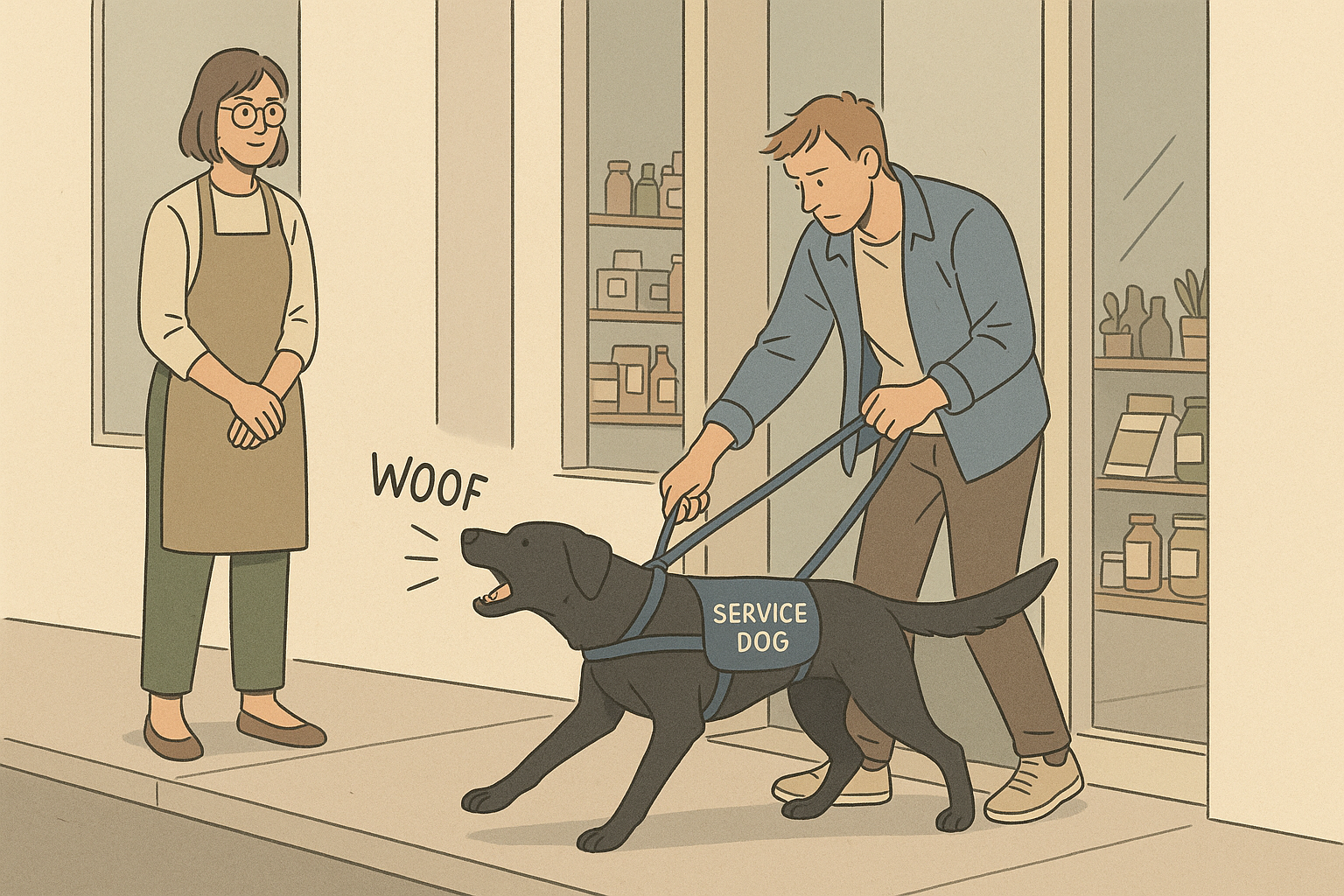
Most conflicts can be prevented long before they reach the point of “deny access.” The best approach is to build a simple system that staff can follow under stress: consistent rules, a calm script, and a clear path to management.
A practical playbook for businesses:
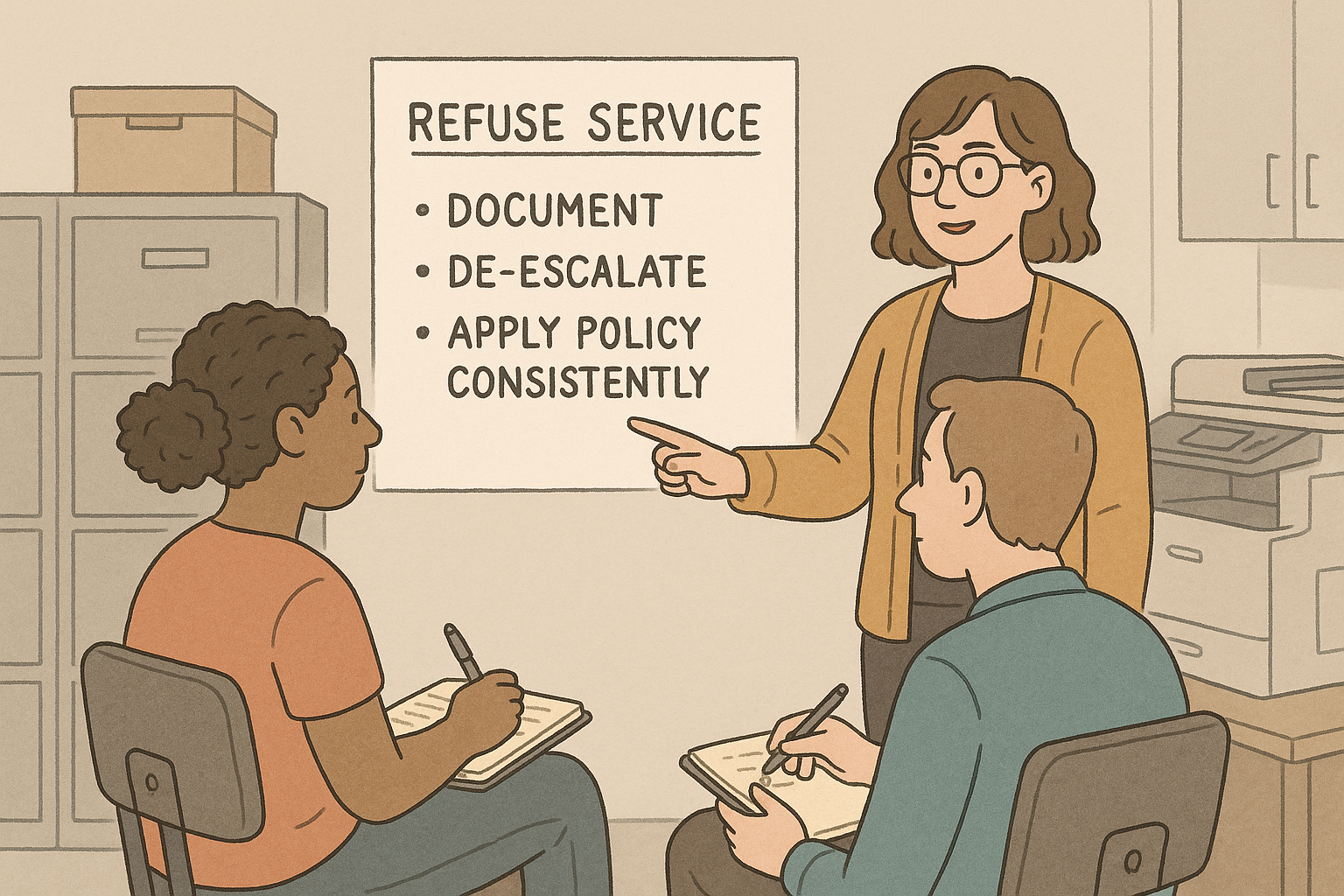
Train staff on consistent enforcement. If your policy is “no profanity at the counter,” enforce it regardless of who’s speaking.
Use de-escalation scripts. Neutral language helps: “I want to help you. Here’s what we can do today.”
Know when to involve a manager. Front-line staff shouldn’t have to improvise legal decisions.
Document incidents. After the situation is calm, note the date/time, what happened, who was involved, and what staff did. Video can help when lawful.
Offer alternatives when possible. If someone can’t be served inside, curbside or remote service may solve the issue without a confrontation.
Use denial as a last resort. Refusing service can be necessary for safety, but it’s also where risk rises. Many business safety guides recommend documenting, using calm communication, and involving law enforcement when needed to reduce legal exposure; see this source.
When service animals are involved, train staff on the narrow reasons a service dog can be removed (out of control without effective handler action, or not housebroken) and on how to ask only permitted questions. The goal is not to “win an argument”—it’s to maintain safety and provide access in a lawful, respectful way.
When a situation is moving fast, staff need a quick mental checklist. Here’s a simple way to decide what to do next without making it personal.
Step 1: Identify the issue.
Is it behavior (yelling, threats, intoxication), a neutral policy (hours/dress), or a health/safety rule?
Step 2: Confirm it’s not tied to a protected trait.
Ask: “Would we do the same thing if a different customer did the same thing?”
Step 3: Confirm consistent enforcement.
If the policy is rarely enforced, denial may look targeted.
Step 4: Consider reasonable accommodations if relevant.
If disability or religious issues are raised, consider alternatives (curbside/remote) where feasible.
Step 5: Document.
Write down what happened and what was said.
Step 6: Decide.
If the issue continues, refuse service or ask the person to leave—calmly and clearly—based on the neutral reason.
Because state and city rules vary, consult local counsel for policy wording, signage, and staff training—especially if you’ve had repeated incidents, operate in multiple locations, or serve the public in a high-conflict environment.
Being denied access with a service dog can feel personal and frustrating—especially if you’re doing everything right. But the fastest path to resolution is usually calm, specific communication.
Practical steps in the moment:
Stay calm and keep your dog close. Your composure helps the situation de-escalate.
Ask for the specific reason. A helpful prompt is: “Can you tell me exactly what policy or behavior issue you’re citing?”
Offer to answer the ADA-allowed questions. If staff are unsure, calmly clarify that you can answer what the dog does (tasks) without sharing private medical details.
Request a manager. Many front-line employees haven’t been trained well; a manager may have more context.
Document what happened. Note the business name, address, date/time, who you spoke with, and what was said. Save receipts or screenshots if relevant.
Plan ahead for travel scenarios. If you’re going somewhere new, having a simple plan—what to say, where to go if entry is delayed, how to keep your dog settled—can lower stress. For more planning tips, see traveling with a service dog.
If you want a simple way to share key points during a tense moment, many handlers keep a brief, readable reference card on hand. Consider ADA law handout cards that you can hand to staff while you focus on keeping the interaction calm.
After the situation is safe, you can decide whether to follow up with the business, file a complaint through the appropriate channel, or seek local guidance. The goal is access and safety—not a confrontation in the doorway.
It’s usually better to stay calm, ask for a manager, and offer to answer the permitted questions about whether your dog is a service animal required because of a disability and what tasks it performs. Escalate afterward if needed.
It can happen. The best move is to regain control quickly. If your dog can’t settle, stepping outside to reset shows good faith and can prevent removal from turning into a broader access dispute.
“ "When I slowed down and asked for the specific reason, the conversation changed. It went from confrontation to problem-solving." — Service dog handler”
Your trusted source for service animal registration. Get professional ID cards, digital profiles, and smart NFC tags to keep your service animal safe and recognized.
© National Animal Registry — All rights reserved.