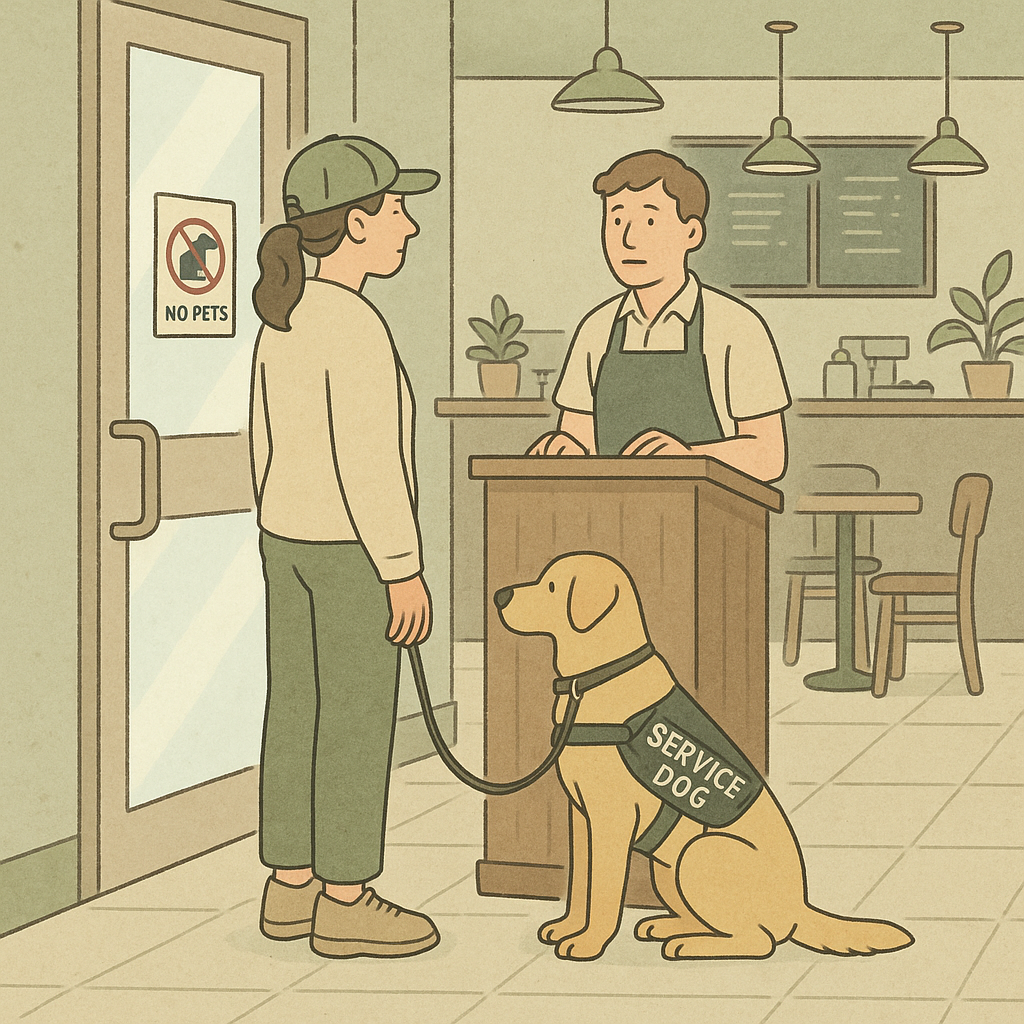
Being refused entry with a service dog can feel frustrating, embarrassing, or even unsafe—especially when you’re simply trying to do something ordinary like buy groceries, check into a hotel, or eat at a restaurant. The good news is you don’t have to guess your way through it. With a calm approach and a few key facts, you can protect your rights while keeping the moment as respectful and low-stress as possible.
This guide walks you through what to say, what businesses can (and cannot) ask, when a removal request might be lawful, and how to document and report a denial if needed.
Access denials happen more often than many people realize—and they’re not a sign you did anything wrong. In many cases, the issue is confusion, not malice. Staff may not be trained on disability access rules, or they may be mixing up three very different categories: pets, emotional support animals, and service dogs.
It’s also common for employees to fall back on a simple rule like “no animals allowed,” without realizing that service dogs are treated differently under federal law. Your goal in the moment is not to “win an argument.” It’s to stay safe, keep your dignity, and move through a clear step-by-step process that focuses on facts and documentation.
“ "Most conflicts I see aren’t about bad intentions—they’re about staff not knowing what the law allows them to ask. A calm, consistent explanation can change the whole tone." – Service dog handler”
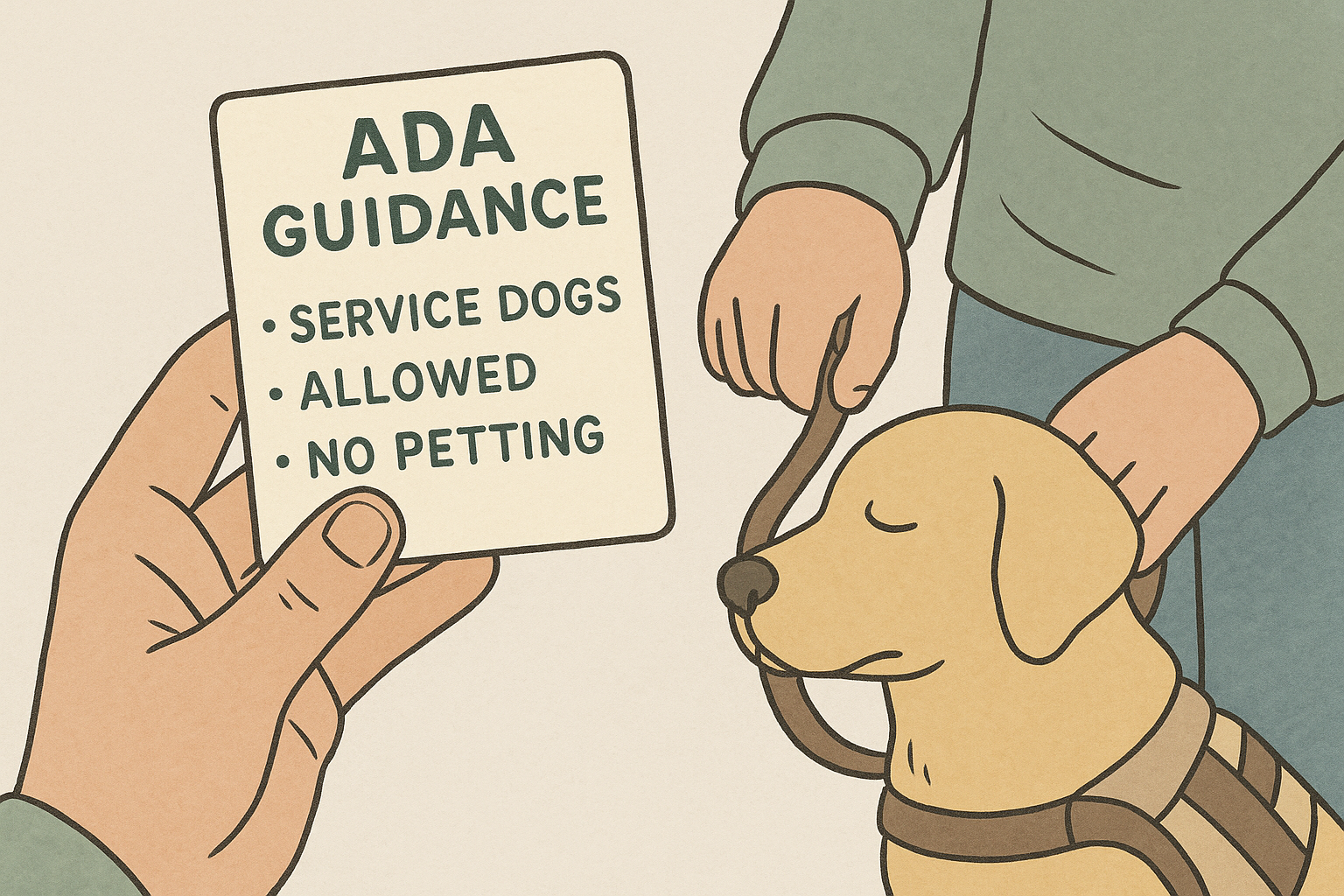
Under the ADA (Americans with Disabilities Act), a service dog is a dog that is individually trained to do work or perform tasks for a person with a disability. The task(s) must be directly related to the disability. Examples can include guiding a person who is blind, alerting to a medical episode, retrieving items, providing mobility assistance, or interrupting certain disability-related behaviors.
In most situations, public-facing businesses and public places must allow service dogs to accompany their handlers. This generally includes restaurants, stores, hotels, and public transportation. The rules are designed to let people with disabilities participate in everyday life with fewer barriers.
It’s also important to know what the ADA does not treat the same way: emotional support animals (ESAs) do not have the same public-access rights under the ADA. That difference is a major reason why staff sometimes respond with skepticism—especially if they’ve previously had difficult experiences with people bringing pets into “no pets” spaces.
The ADA focuses on whether the dog is individually trained to perform disability-related work or tasks—not who trained the dog. Many handlers train their own dogs or use a mix of resources.
Generally, yes. Public-facing businesses must allow service dogs, with narrow exceptions for dogs that are out of control, not housebroken, or pose a direct safety threat.
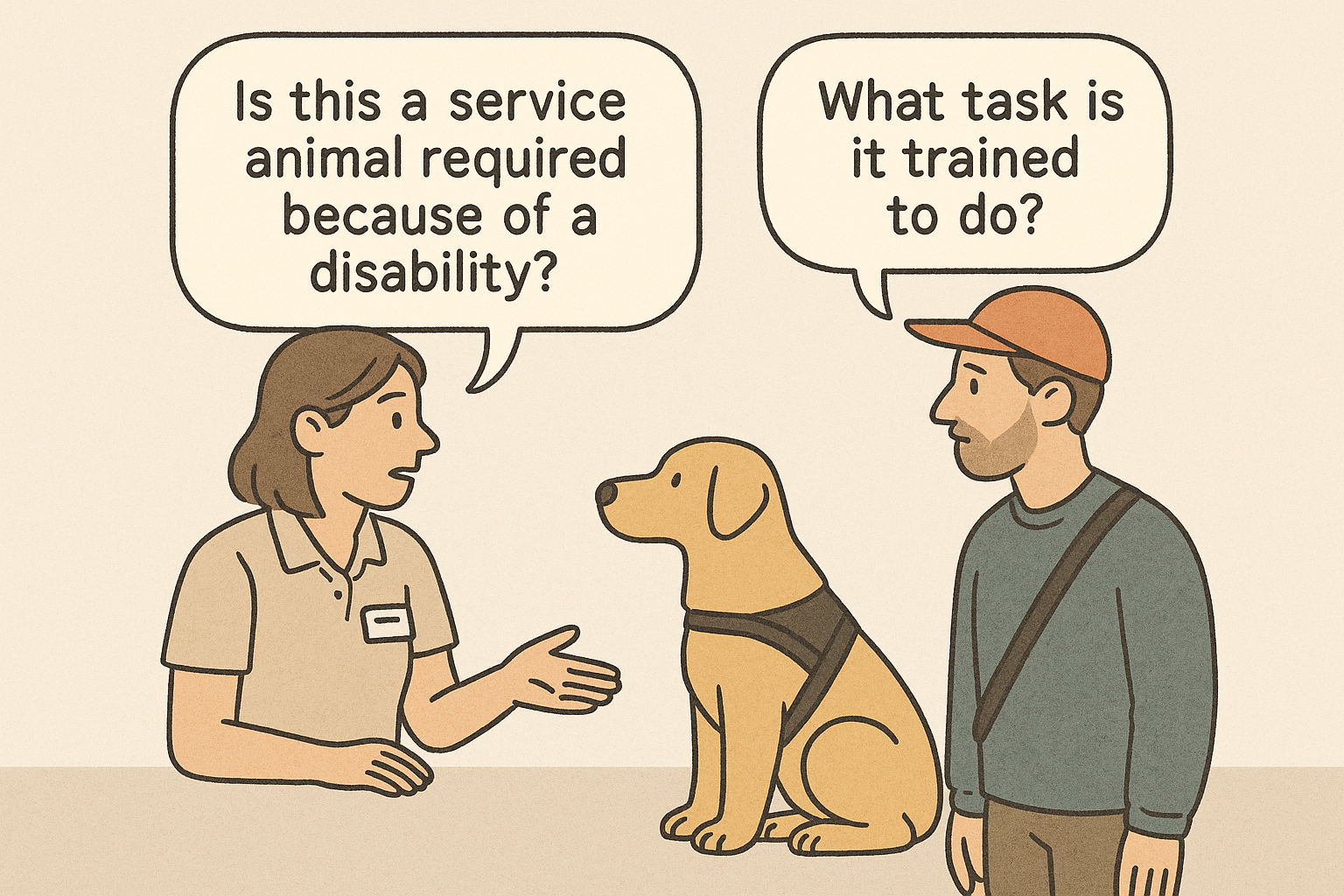
When it’s not obvious what service your dog provides, staff are allowed to ask only two questions: (1) “Is the dog a service animal required because of a disability?” and (2) “What work or task has the dog been trained to perform?” This is a key point that protects both privacy and access rights. You can read the official guidance here: source.
Just as important: staff cannot require you to show an ID card, certification, paperwork, or medical documentation. They also cannot demand that your dog demonstrate the task. And in general, they cannot charge extra fees just because your dog is with you.
A simple way to answer is to be brief and task-focused—without sharing personal medical details. For example: “Yes, this is my service dog. He’s trained to alert me to a medical episode,” or “Yes. She’s trained to help with mobility and retrieve items.”
When someone stops you at the door, your tone matters as much as your words. A calm response can reduce defensiveness and help the staff member switch from “enforcement mode” to “problem-solving mode.”
Here’s a respectful script you can adapt:
“Hi there—this is my trained service dog. Under the ADA, service dogs are allowed in public areas. If you need to confirm, you can ask: (1) whether he’s required because of a disability, and (2) what task he’s trained to perform.”
If they ask for proof or certification, you can say:
“I understand the confusion. The ADA doesn’t allow businesses to require an ID card or certification for a service dog. I’m happy to answer the two permitted questions.”
While you’re talking, keep your dog close, quiet, and under control—at heel or in a tucked sit/down. That visual calm goes a long way in showing you’re responsible and that the dog is working.
“ "I’ve found that the simplest approach is best: identify the dog as a service dog, name the two questions, and then pause. Silence gives them room to process." – Experienced handler”
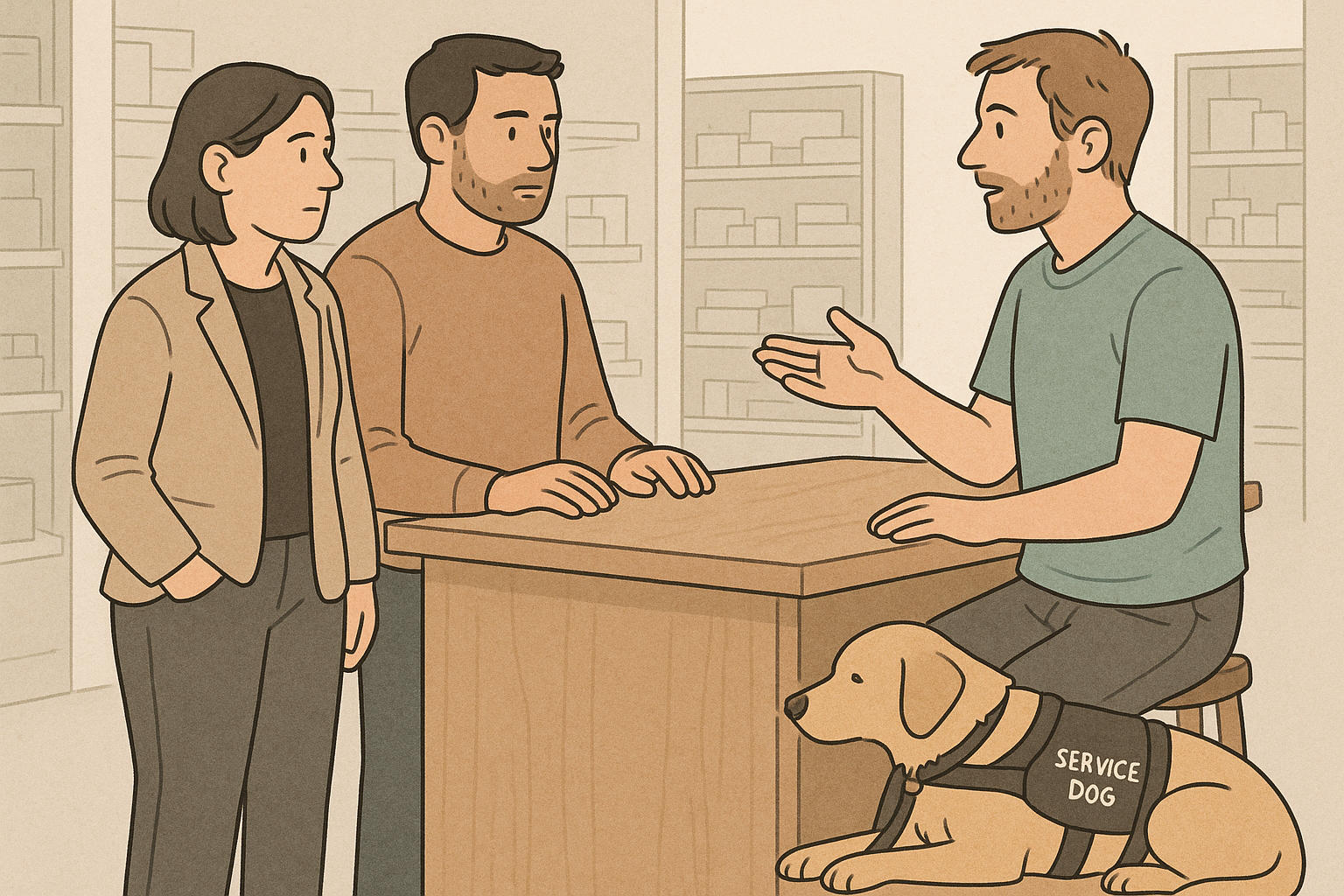
If the employee won’t allow entry, the next best step is to calmly ask for a manager. Many front-line staff members are trying to follow a “no pets” policy and may not feel authorized to make exceptions, even when the law requires it.
Try something like: “Could we involve a manager for a quick clarification? I’d like to resolve this respectfully.” Then repeat the key points: your dog is a service dog; they may ask only the two questions; they can’t require ID or documentation.
Some handlers find it helpful to carry a small, plain-language reference card they can offer in a non-confrontational way. Done correctly, it doesn’t escalate the situation—it reduces confusion and helps the manager train staff later. If you want something easy to keep in a wallet or bag, consider ADA law handout cards.
It’s usually more effective to repeat the two-question rule calmly and ask for a manager. If the situation becomes hostile or unsafe, leave and document what happened instead.
Service dog access is strong—but it isn’t unlimited. There are narrow situations where a business may lawfully ask that a service dog be removed. These exceptions are based on behavior and safety, not on personal preferences.
A business may ask you to remove the dog if:
• The dog is out of control and you do not take effective action to control it.
• The dog is not housebroken.
• The dog poses a direct threat to the health or safety of others.
On the other hand, these are not valid reasons to deny access:
• Allergies to dogs
• Fear of dogs
• Breed or size restrictions
• “No pets” policies applied to service dogs
If the business legitimately requires the dog to be removed, they should still allow you to access goods and services without the dog when feasible. In other words, removal isn’t supposed to become a total denial of service if there’s a workable alternative.
“ "A well-behaved service dog is your strongest proof in real life. Quiet, controlled, and focused—those details prevent most conflicts before they start." – Retail manager”
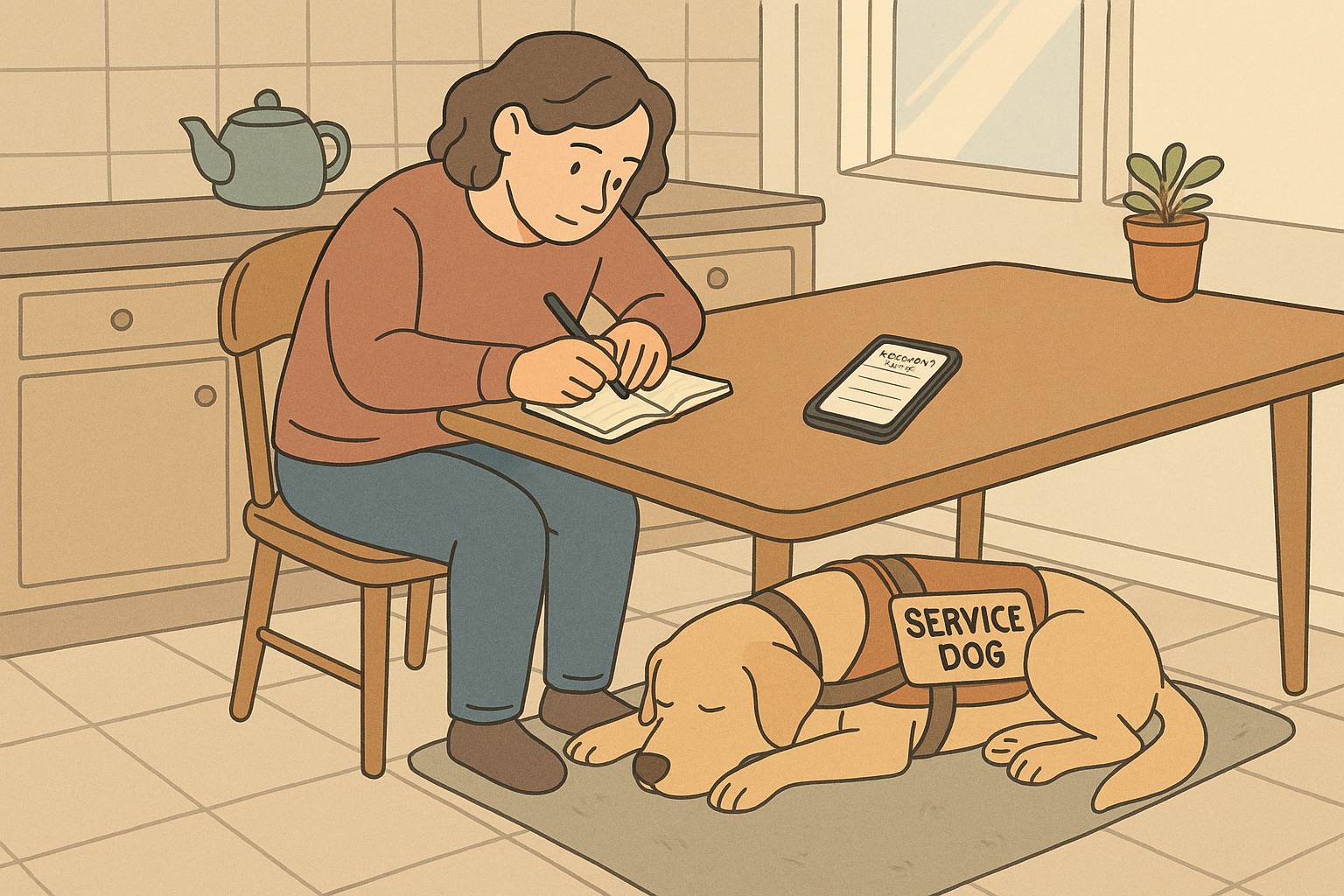
If you’re denied entry—or if the situation becomes stressful—write down what happened as soon as you safely can. Even a few minutes later, small details (like exact wording or who said what) can get fuzzy. Clear notes help if you choose to file a complaint, follow up with corporate management, or simply keep a personal record.
Try to keep your notes factual and unemotional. You’re building credibility: who, what, where, when, and the exact language used.
If a business illegally refuses service dog access, you have options. Many people start by contacting the business owner or corporate office with a calm summary and a request for staff retraining. But if that doesn’t resolve the issue—or if the denial is severe—you can consider formal complaint routes.
For public-access issues, complaints can be filed with the U.S. Department of Justice (DOJ) for ADA violations, including online submission. You may also have state or local civil rights agencies that handle disability discrimination complaints. In addition, local disability rights organizations can sometimes help you understand your options, write a clear timeline, or identify the best agency for your situation.
When you file, include your documentation, stick to a simple timeline, and be clear about what outcome you want. Many people aren’t looking for drama—they’re looking for practical fixes like a policy change, staff training, or a resolution that prevents the next handler from being turned away.
Common goals include updated policies, staff training, a written apology or confirmation of access, and preventing repeat denials. Some cases also lead to settlements or formal enforcement.
Air travel can feel like its own world—and in many ways, it is. Airlines follow U.S. Department of Transportation (DOT) rules, and the process can involve specific forms and steps that look different from everyday public access. That difference can catch handlers off guard, especially during stressful travel days.
In general, refusals shouldn’t be based on breed or size alone, and they shouldn’t be based on other passengers’ discomfort. If DOT forms are required for your trip, complete them according to the airline’s instructions and timeline.
If you’re blocked at the airport or gate:
• Stay calm and ask for a supervisor or a CRO (Complaint Resolution Official) if available.
• Keep your explanation short: your dog is a service dog, and you’re following the airline’s required process.
• Avoid arguing with frontline staff when the line is moving—request escalation politely.
• After the trip (or once you’re safe), write down details and follow the airline’s complaint process.
For more planning tips, see our guide on traveling with a service dog.

An illegal refusal of service dog access can amount to disability discrimination. While many situations resolve through education or a complaint process, it’s still helpful to understand that the law has enforcement tools. Federal enforcement can involve substantial fines, and some states also impose penalties for denying access.
That said, deciding whether to consult an attorney is a practical choice—not a requirement. Consider seeking legal advice if you’re dealing with repeat denials at the same business, a pattern of discrimination, serious harm, loss of access to essential services, or a situation where the business retaliated or escalated beyond a simple misunderstanding.
Even if you don’t pursue legal action, documenting and reporting a denial can push real change—especially when it leads to staff training and better policies.
In access conflicts, you’ll often hear the same phrases repeated. Having a one-sentence response ready helps you stay calm and consistent—without turning the moment into a debate.
Here are common myths and simple corrections you can use:
“ "I used to over-explain and it made things worse. Now I give one clear sentence and offer to answer the two questions. It’s faster and calmer." – Service dog handler”
You can’t control every interaction, but you can reduce friction by preparing for the most common pain points. In day-to-day life, the smoothest entries usually happen when your dog is calm, under control, and you’re ready with a brief explanation.
Practical steps that help:
• Keep your dog under control: solid leash handling, calm heeling, and quiet waiting make a strong first impression.
• Practice a relaxed settle: a tidy sit or down next to your leg is often the difference between “concern” and “confidence” from staff.
• Carry a short ADA reference card: while IDs aren’t required under the ADA, many handlers choose to carry clear, ADA-friendly information to reduce misunderstandings.
• Travel prep matters: when flying, follow airline instructions for DOT forms, arrive early, and plan your route through the airport.
If you’d like something simple to hand over without arguing, consider a small ADA reference card to keep in your wallet, vest pocket, or travel bag.
They can reduce confusion and speed up conversations with uninformed staff. They’re not a legal requirement for access, but some people find they help with smoother day-to-day interactions.
Keep your dog under control and be ready to answer the two permitted questions clearly and briefly. Calm behavior plus a consistent script prevents many situations from escalating.
Your trusted source for service animal registration. Get professional ID cards, digital profiles, and smart NFC tags to keep your service animal safe and recognized.
© National Animal Registry — All rights reserved.