Fun Training Activities for Service Dogs

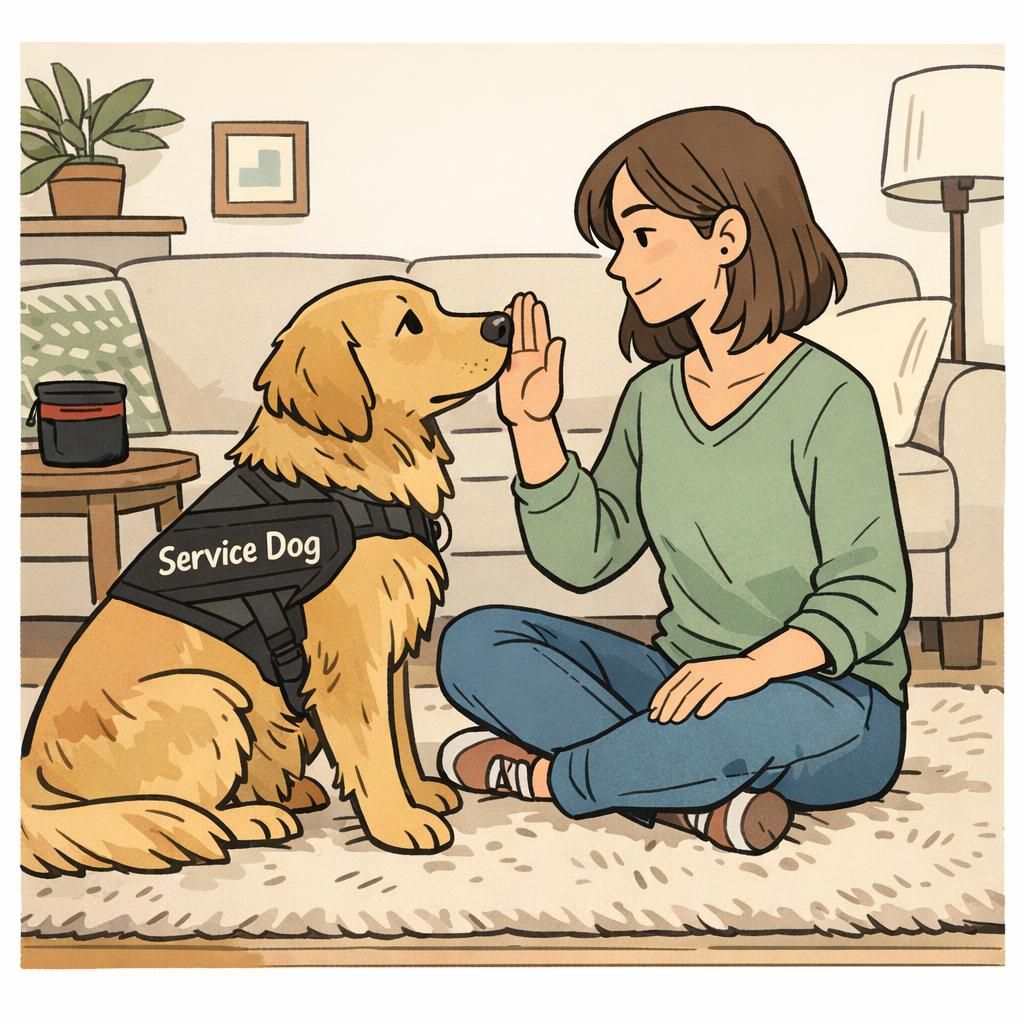
Handler guiding an adult service dog to touch a palm in a calm indoor training session on a soft rug while the dog wears a visible working vest.

Training That Feels Like Play: Why Fun Matters for Service Dogs

Service dog training is often associated with seriousness: steady manners, consistent responses, and calm behavior in public. But “serious” doesn’t have to mean dull. In fact, many of the most reliable working behaviors are built through upbeat, playful practice that keeps your dog engaged and confident.

Fun training activities help your dog rehearse focus in a low-pressure way. They also create a history of success—your dog learns that listening leads to good outcomes, and that working with you is rewarding. Over time, that positive association can translate into steadier behavior when real life gets distracting.

The goal is not to hype your dog up—it’s to make training enjoyable, clear, and repeatable so reliability grows without stress.
  • Keep sessions short (often 3–8 minutes), and end on a win.
  • Match the activity to your dog’s age, health, and task needs—what’s fun for one dog may be too much for another.
  • Use clear start/stop cues so your dog learns when it’s “work,” “play,” and “all done.”
  • Prioritize calm enthusiasm: reward focus, good choices, and smooth transitions back to a settle or heel.

Safety First: Warm-Ups, Surfaces, Weather, and Joint-Friendly Choices

Training games are only helpful if they keep your service dog healthy and comfortable. A few simple safety habits can prevent sore joints, strained muscles, or weather-related stress—especially during higher-energy activities like fetch, tug, or obstacle-style confidence work.

  • Warm up before active games: 2–5 minutes of easy walking, gentle turns, and a few simple cues (sit/down/stand) can prepare muscles and joints.
  • Choose safe footing: grass, rubber mats, and good traction surfaces reduce slipping. Avoid slick floors, loose gravel, ice, or steep uneven terrain when possible.
  • Watch intensity and repetition: multiple short sets are typically safer than one long session. Stop early if you notice limping, lagging, or “sloppy” movement.
  • Support joints with smart game choices: avoid repeated sharp turns or high-impact jumping if your dog is prone to joint sensitivity.
  • Plan for weather: in heat, keep sessions brief, seek shade, carry water, and prioritize calmer mental games; in cold, consider protective layers and keep moving to prevent stiffness.

Weather changes how your dog experiences the same activity. On hot days, a routine that’s normally easy can become too intense. On cold days, muscles can feel tighter and traction can be unpredictable. Adjusting your plan isn’t “skipping training”—it’s smart handling that supports your dog’s long-term working career.

Play Catch With Purpose: Exercise Plus Impulse Control

Fetch and catch games can be more than exercise—they can become a structured lesson in impulse control, clean retrieves, and smooth transitions back to working position. The key is to keep the game predictable and joint-friendly, so your dog stays safe and focused.

Start with a simple routine: your dog sits, waits, and only moves on your release cue. Then add “take it,” “drop it,” and a calm return to you (or straight into a heel). By layering cues, you’re teaching your dog to think even when excited—exactly the skill that helps in real-world service work.

  • Step 1: Ask for a sit and a short “wait.” Reward calmness before you ever throw.
  • Step 2: Use a clear release cue (like “okay”) before the dog moves.
  • Step 3: Make low, straight throws to reduce hard braking and twisting.
  • Step 4: Cue “take it” when your dog reaches the toy, then “bring” or “here” for the return.
  • Step 5: Cue “drop it” into your hand or at your feet, then immediately ask for a heel or a down-stay.
  • Step 6: End the game while your dog still wants more—then do a calm settle to practice switching gears.

To keep this game safer and more comfortable, use shorter distances, limit repetitions, and prioritize low, straight throws—especially for dogs that get intense about chasing. Adjusting for temperature and choosing joint-friendly throws are commonly recommended ways to reduce strain and avoid heat or cold discomfort during active play (source).
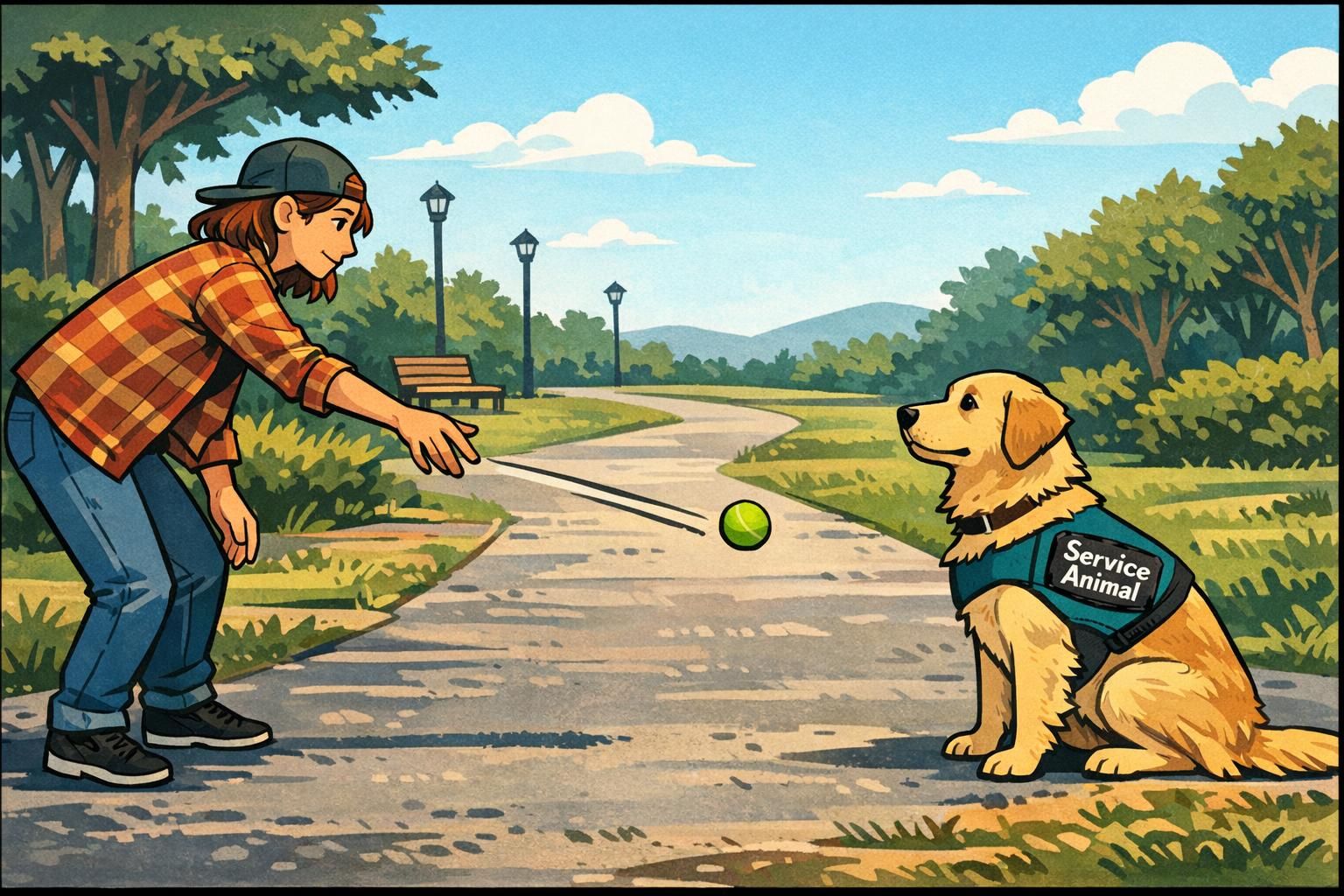
Handler tosses a low, straight ball on a park path while a service dog waits in a sit, practicing calm release, recall, and controlled movement with a working vest on.

Hand Target “Touch”: A Fun Foundation Skill for Real-World Handling

A hand target—teaching your dog to boop your palm with their nose on cue—is one of the most useful “fun” skills you can build. It’s simple, upbeat, and incredibly practical for guiding your dog through busy environments without pulling, nagging, or repeating commands.

Once your dog loves “touch,” you can use it to reposition at your side, move around obstacles, orient toward you when distracted, or smoothly line up for a heel. Because it’s often taught with quick rewards, many dogs offer it happily—even when they’re unsure or overstimulated.

  • Teach it: Present an open palm a few inches away. When your dog’s nose touches, mark and reward.
  • Add the cue: Say “touch” once, then present your hand. Reward the contact.
  • Build reliability: Practice from different positions (standing, seated, wheelchair side, etc.).
  • Scale difficulty thoughtfully: increase distance first, then add brief duration (1–2 seconds of contact), then add distractions.
Instead of repeating “touch, touch, touch,” make it a one-cue game: give the cue once, pause, and help your dog succeed by moving closer or lowering the distraction.

Tug Games That Build Tasks: Start, Stop, and Gentle Handling

Tug can be a structured, confidence-building reward when it has clear rules. For many service dogs, controlled tug also becomes a stepping-stone to practical skills like holding an item, delivering it to hand, or learning to apply gentle, sustained pressure on an object (when appropriate for the dog and handler’s goals).

The most important part is teaching a clean start and a clean stop. Your dog should be able to engage without getting frantic, and disengage immediately when asked. That “off switch” matters for public access manners and overall reliability.

  • Teach “take”: Offer the tug and reward your dog for gripping gently (not thrashing). Keep the game close to your body and low to the ground.
  • Teach “give”: Hold the toy still, trade for a treat, then return to tug as a bonus reward.
  • Add “all done”: End the game the same way every time—toy disappears, hands relax, and your dog transitions into a simple cue like down-stay.
  • Keep it joint-friendly: avoid yanking upward or encouraging big leaps; think steady, controlled motion.
  • Adapt for limited hand strength: use larger, softer tug toys or fleece tugs that are easier to hold, and play short rounds.

“ "When we added a clear ‘give’ and ‘all done,’ tug stopped being chaotic and became one of our best rewards for focused work." – Service dog handler”

Scent Work and “Find It” Games: Calm Focus You Can Train Anywhere

If your dog gets mentally tired faster than physically tired (common for working dogs), scent games can be a perfect fit. Nose work encourages calm, methodical problem-solving and can be done in small spaces with minimal equipment.

Start by pairing the search with a consistent cue like “Find it.” Over time, that cue becomes a helpful decompression tool: a short, sniffy game between errands or working sessions can help your dog reset and come back to you with a clearer head.
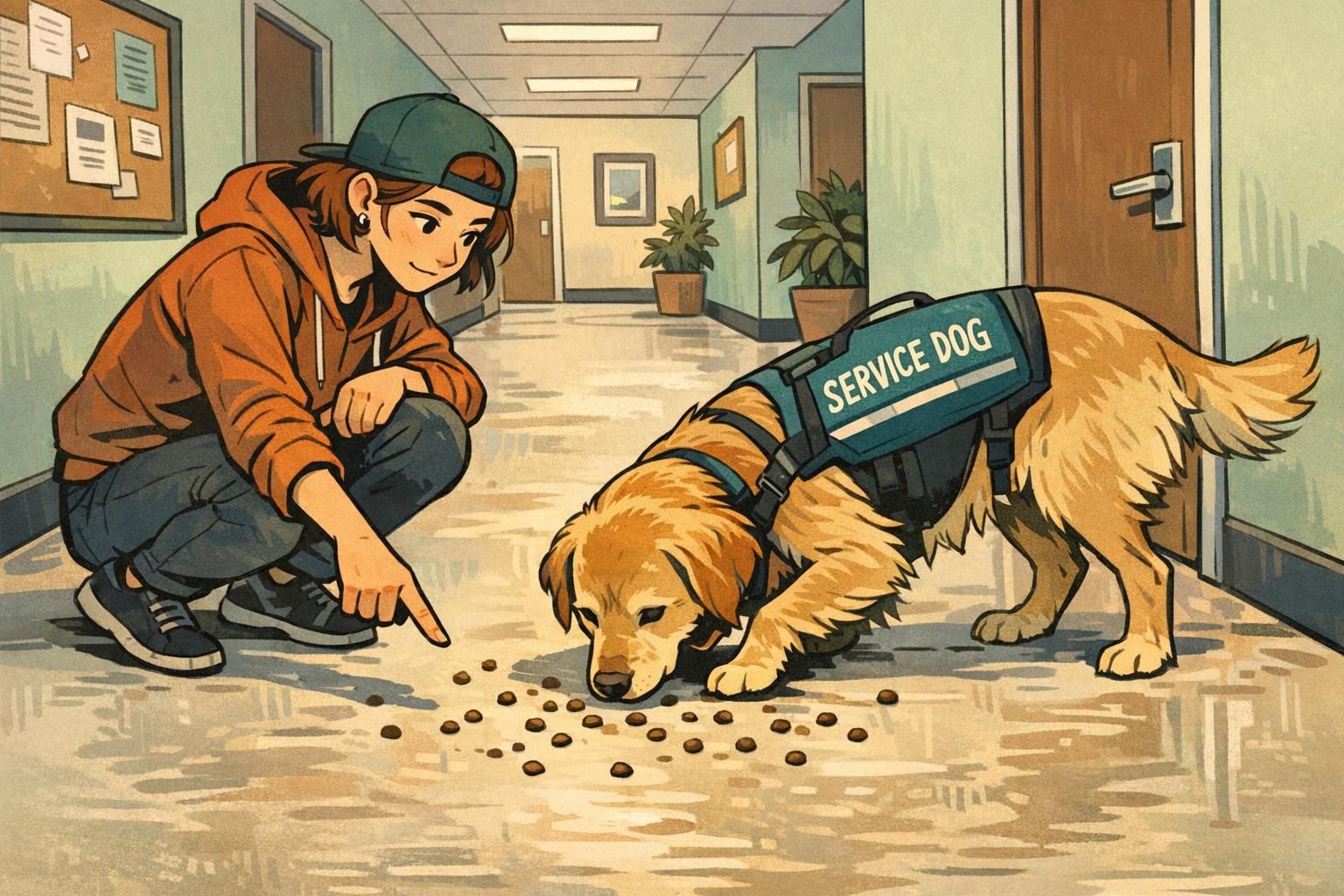
  • Scatter kibble in a small area of grass or on a snuffle mat and cue “Find it.”
  • Hide a few treats behind chair legs or under the edge of a rug (easy mode first).
  • Use three cups: hide a treat under one cup and let your dog indicate which one.
  • Create “search lanes” in a hallway by placing treats every few feet, then spacing them farther apart as your dog improves.
Service dog sniffs along an indoor hallway to find scattered kibble while the handler points and cues, practicing focused scent work and calm searching with a working vest.

Puzzle Feeders and DIY Brain Games for Rainy Days

On days when outdoor time is limited, puzzle feeders and simple DIY enrichment can keep your service dog engaged without revving them up. Food-dispensing toys, lick mats, and “find the treat” setups turn mealtime into a training opportunity for persistence and emotional regulation.

A great rainy-day rule: make the puzzle challenging enough to be interesting, but easy enough that your dog stays confident. If your dog paws, whines, or quits, it’s a sign to lower difficulty so the game stays fun.
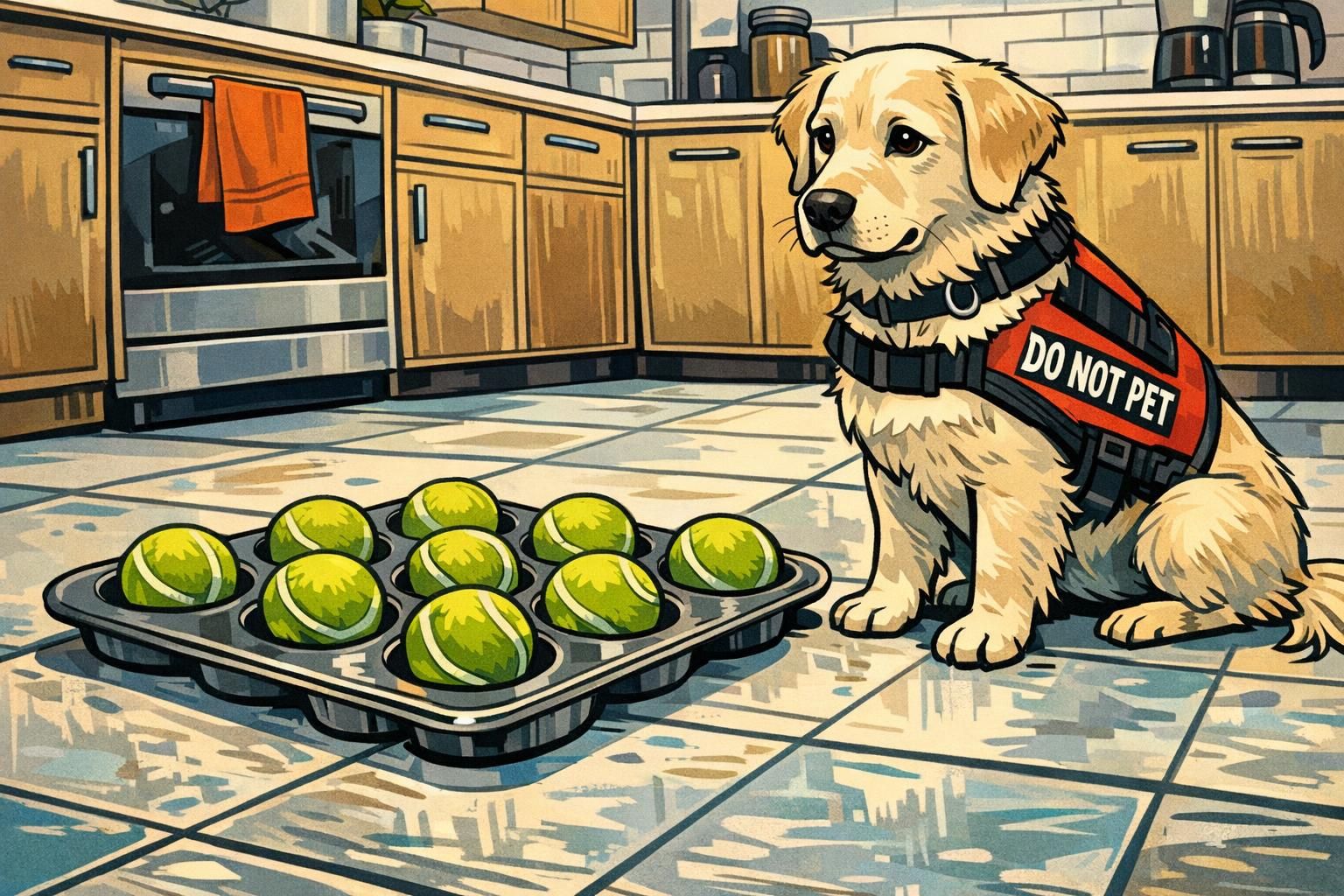
  • Muffin tin game: place treats in a few cups and cover with tennis balls for your dog to nudge aside.
  • Towel roll-up: sprinkle kibble on a towel, roll it loosely, and let your dog unroll it to eat.
  • Box search: hide treats in a few cardboard boxes and encourage your dog to sniff and choose.
  • Frozen enrichment: freeze a thin layer of wet food or broth in a slow feeder for a longer-lasting, calming activity.
A muffin tin treat puzzle covered with tennis balls sits on a kitchen floor as a service dog watches calmly, practicing problem-solving and patient engagement.

Confidence and Coordination Courses: Safe Obstacles for Body Awareness

Body awareness is a hidden superpower for service dogs. Dogs that know where their feet are can move more carefully in tight spaces, step over thresholds smoothly, and recover faster if they get startled. A simple confidence and coordination course can build that skill without needing full agility training.

Keep obstacles low and stable, and move at your dog’s pace. The goal is thoughtful movement—slow steps, controlled turns, and calm engagement—not speed. Celebrate small progress and give your dog choices to opt in.
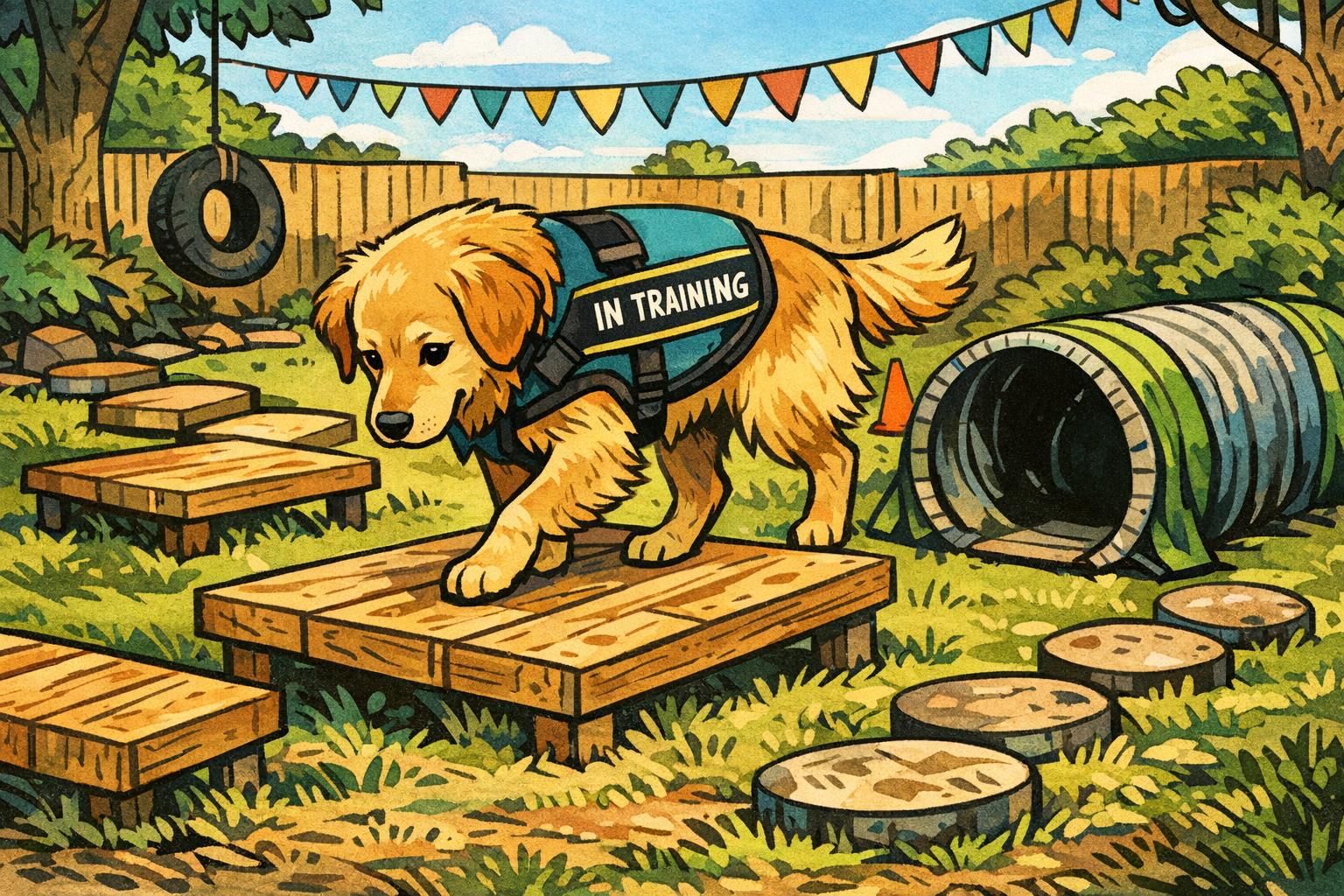
  • Platforms and pauses: step up onto a low platform, then pause for 2 seconds before stepping off.
  • Cavaletti-style poles: use broomsticks or pool noodles on the ground to encourage careful stepping.
  • Wobble surfaces (beginner): a sturdy cushion or low balance pad with support and short repetitions.
  • Tunnels (easy): a short, open tunnel or a draped blanket “arch” that doesn’t touch your dog’s back.
If your dog hesitates, that’s information—not refusal. Lower the obstacle, reduce the movement, and reward curiosity.
Service dog steps onto a low, stable platform in a backyard confidence course near a short tunnel, building body awareness, coordination, and careful footing.

Obedience Games That Keep Skills Sharp

Obedience doesn’t have to feel repetitive. When you turn core cues into mini-games, you keep skills fresh while reinforcing the calm, responsive behaviors that matter most for working life.

A simple structure helps: clear start, quick practice, clear end. Your dog learns that focusing for a short burst leads to rewards and then a break—an excellent pattern for real-world routines.

  • The “3-cue challenge”: ask for sit, down, and touch in any order; reward after all three.
  • Stay-and-return: ask for a short stay, take one step away, return and reward before your dog moves.
  • Heel loops: do three steps of heel, stop, reward; repeat with one small turn added.
  • Recall ping-pong: two people gently alternate short recalls, rewarding calm arrivals and a sit.

Change one thing at a time: add distance or distraction in tiny increments, and temporarily increase your reward rate. If your dog struggles, step back to an easier version and rebuild.

Choose lower-arousal rewards (treats instead of high-energy play), slow your movements, and add a quick settle between repetitions so your dog practices switching gears.

Indoor Training Circuits for Extreme Weather

When it’s too hot, too cold, or too stormy to train outside, an indoor circuit can keep your dog moving and thinking. You don’t need a lot of space—just a plan that includes both movement and focus.

  • Hallway heeling: practice 10–20 feet of heel with one turn and one stop.
  • Stair recalls (if appropriate): one person holds the dog, the other calls once; reward calm arrivals. Keep repetitions low.
  • Treat searches: cue “Find it” and scatter a small handful of kibble in a controlled area.
  • Place-to-place: send your dog between two mats or beds, rewarding a calm down on each.
Indoor safety check: clear slippery clutter, use non-slip mats where needed, and keep intensity controlled to avoid skids on hard floors.

Sample Weekly Activity Plan: Rotate for Balance, Not Burnout

A well-rounded week balances physical movement, mental work, real-life practice, and intentional rest. Rotating activities helps prevent overuse injuries and keeps your dog excited about training.

Use this as a flexible template, not a strict schedule. Track what your dog looks like on different days: Are they more focused after scent work? More relaxed after a short tug session? That information helps you build the routine that best supports your dog’s well-being.

  • Day 1: Short fetch with impulse control + 5-minute settle practice
  • Day 2: Scent work “Find it” + light obedience mini-games
  • Day 3: Confidence course (slow, low obstacles) + puzzle feeder at dinner
  • Day 4: Indoor circuit (heeling + searches) or calm walk depending on weather
  • Day 5: Tug with clear start/stop + recall refreshers
  • Day 6: Easy decompression day (sniff walk or gentle enrichment) + brief public-access-style settle at home
  • Day 7: Rest or very light training (one or two easy wins, then relax)

“ "Rotating nose work, obedience, and play gave us better focus than doing the same long routine every day." – Service dog handler”

Everyday Public Access Practice: Staying Polite, Calm, and Consistent

Public access skills are built one calm repetition at a time. Instead of waiting for a big outing, practice in short, controlled moments: a quiet entrance, a brief stop near a checkout line, or a calm settle on a patio during off-peak hours.

  • Start small: choose quieter times and less crowded locations so your dog can succeed.
  • Practice “settle under the table”: reward your dog for relaxing, not just for staying in place.
  • Use controlled greetings: if you allow greetings, put them on cue and end them promptly.
  • Build duration slowly: leave while things are still going well, so your dog’s last memory is success.
  • Stay consistent with your cues and expectations, even when people are watching.

Rules and expectations can vary by location, and sometimes you may be asked questions in the moment. Many handlers like having a simple tool ready so conversations stay calm and brief, such as ADA law handout cards for calm, clear conversations in public.
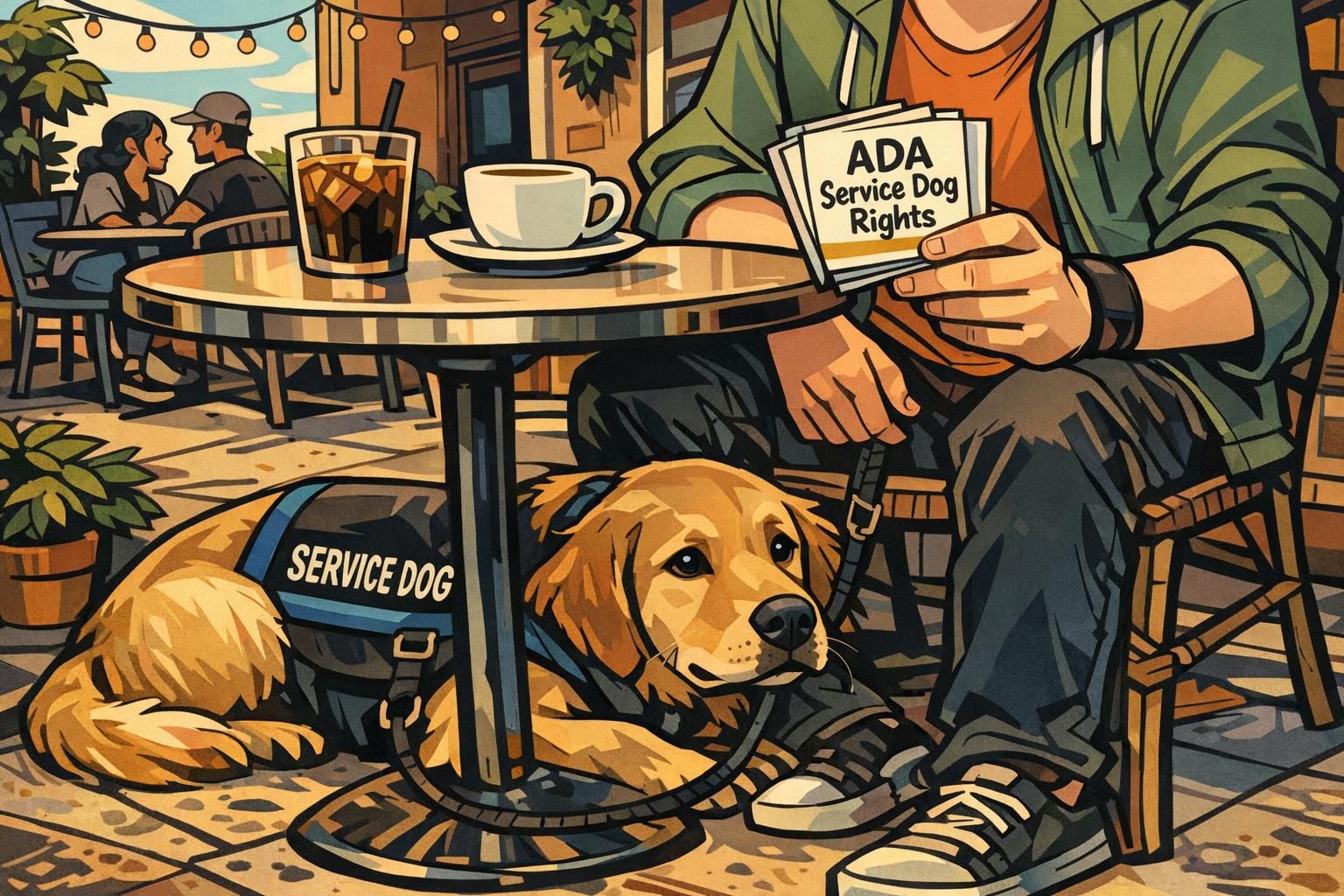
Service dog settled under a coffee-shop table beside a handler holding informational cards, practicing polite public-access positioning and calm presence.

Helpful Identification for Daily Life: Keeping Info Organized and Accessible

As you build your dog’s skills through consistent training and real-life practice, organization can make daily life smoother. Many handlers choose optional registration, IDs, and certificates as a practical way to keep important details in one place and reduce friction during common situations like travel, housing conversations, or entering new environments.

Think of documentation as a convenience tool: it helps you stay prepared, communicate more easily when questions arise, and feel more confident navigating busy routines. It can also be helpful when multiple caregivers, family members, or support professionals are involved—everyone can reference the same information quickly.

  • Keeps key details organized in one consistent profile
  • Provides an easy-to-carry ID for everyday situations
  • Supports smoother conversations during travel, errands, and transitions
  • Helps reduce stress by making your information accessible when you need it

If you’re looking for a simple way to keep everything together, many handlers start with a starter registration package for everyday identification. And if you’re preparing for a trip, you may also like travel planning tips for trips with a service dog.

The best training plan is the one you can sustain: short, fun activities—paired with calm consistency—build the reliability service dogs are known for.