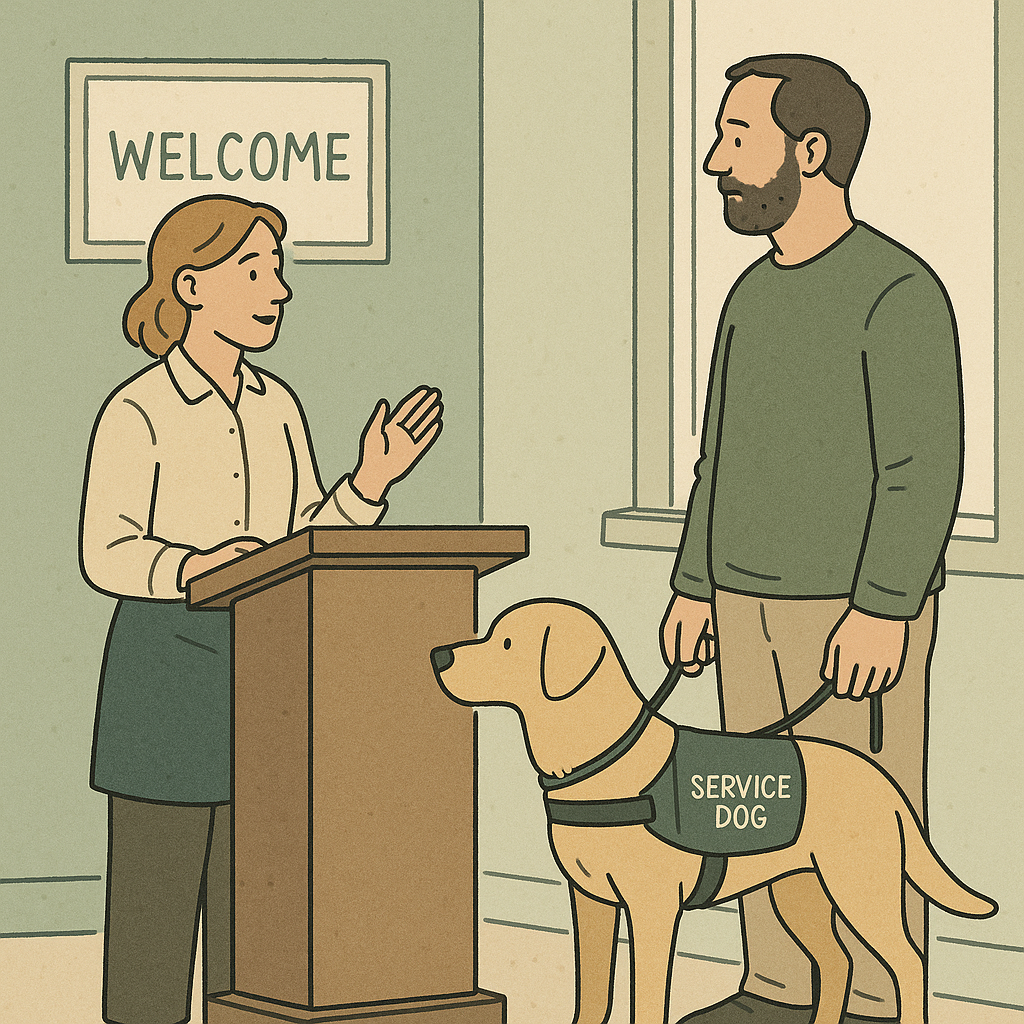
If you run a business—or you manage a front desk, host stand, customer service counter, or security team—you’ve probably had this moment: a customer enters with a dog, and you’re not sure what you’re allowed to ask.
The good news is that the ADA gives a clear, practical framework. The even better news is that you don’t need to be a lawyer to follow it. You just need to know (1) what counts as a service animal under the ADA, (2) the only two questions you’re allowed to ask in certain situations, and (3) how to handle behavior issues in a fair, consistent way.
This guide is designed to help business owners, managers, and frontline staff stay ADA-compliant while keeping interactions respectful—so customers with disabilities feel welcome and your team feels confident.
Under the Americans with Disabilities Act (ADA) in Titles II and III, a service animal is generally a dog that has been trained to do work or perform tasks for a person with a disability. The key idea is tasks or work—specific actions the dog performs that help with a disability.
There’s also a limited category where miniature horses may be considered in certain circumstances, depending on factors like whether the facility can reasonably accommodate them.
It’s also important to know what is not a service animal under the ADA:
Emotional support animals (ESAs) and therapy animals can provide comfort and companionship, and they can be incredibly meaningful. But under the ADA, comfort alone isn’t the same as trained work or tasks. That means ESAs and therapy animals do not have the same public access rights as ADA service dogs in places like restaurants, stores, and many other public-facing businesses.
“ "The simplest way we train staff is: focus on what the dog does, not what you think the person has." – Operations manager, retail chain”
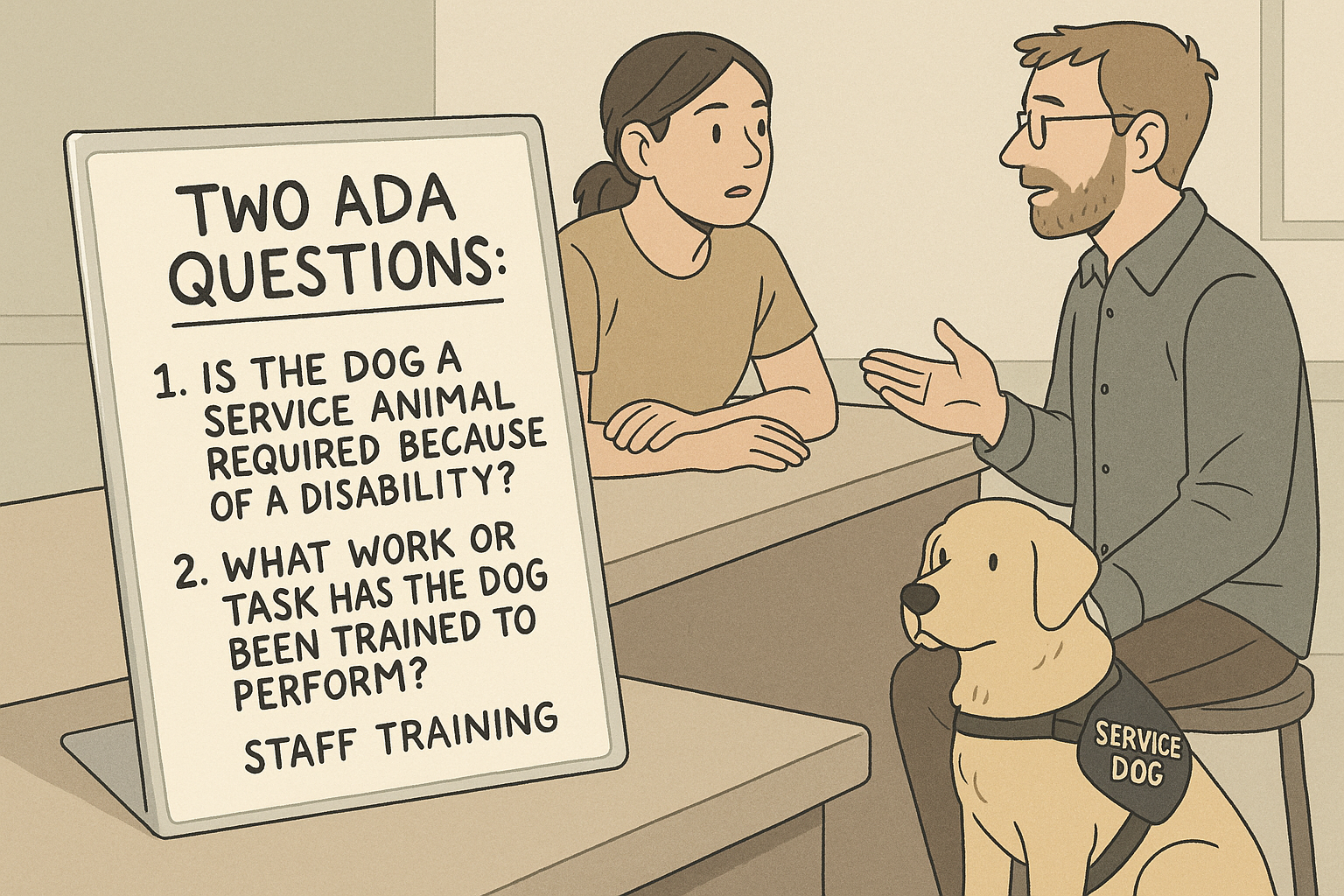
When it isn’t obvious that a dog is a service dog, the ADA allows businesses to ask only two questions. These questions are designed to confirm that the dog is a service animal without forcing the customer to share private medical details.
The two permitted questions are:
1) Is the dog required because of a disability?
2) What work or task has the dog been trained to perform?
This is a narrow lane. Staying in it protects your business and protects the customer’s privacy. For additional clarity, see the ADA’s own guidance here: source.
Acceptable answers to the second question usually describe a trained action the dog performs. For example:
• “He guides me around obstacles.”
• “She alerts me before I have a medical episode.”
• “He retrieves items I can’t pick up.”
• “She interrupts self-harm behaviors and grounds me.”
Notice what’s missing: the customer does not need to name their diagnosis, explain their medical history, or prove anything in the moment. Your staff should listen for a task description, not a disclosure.
Sometimes the dog’s role is obvious—like a guide dog leading a person who is blind. In situations like these, staff shouldn’t question the handler. The best approach is to simply provide normal customer service.
In practice, “obvious” often means the dog is clearly working and the task is apparent from what you can see, without a conversation. If your team isn’t sure whether something is obvious, a good training approach is to default to customer service first: greet the customer, offer help like you would for anyone, and only move to the two questions if the situation truly requires it.
A simple training tip: remind staff that many disabilities are not visible. “Not obvious” doesn’t mean “not real”—it just means the dog’s job isn’t visually clear. That’s exactly what the two ADA questions are for.
When staff are stressed, it’s easy to overreach—especially if someone complains or a “no pets” rule is posted. But under the ADA, certain questions and demands cross the line.
Here are common prohibited moves to avoid:
• Asking what the person’s disability is
• Requesting medical documentation
• Demanding proof of training or certification
• Requiring the dog to demonstrate its task
• Demanding an ID card, vest, badge, or “papers” as a condition of entry
• Asking for health records beyond generally applicable local rules that apply to all dogs
What to do instead? Use a short, consistent script that either returns you to the two permitted questions or ends the conversation and continues service.
“ "Thanks for bringing your service dog in. If you don’t mind, I just need to ask our two ADA questions: Is your dog required because of a disability, and what task is it trained to perform?" – Example script for hosts and greeters”
Service dogs must be allowed anywhere the public is allowed to go—even in businesses that don’t allow pets. That includes dining areas, hotel lobbies, retail aisles, waiting rooms, and more.
Just as important: businesses cannot charge extra fees, deposits, or surcharges simply because a customer has a service dog. A “pet fee” or “animal deposit” that applies only because the dog is present is not allowed.
Practical examples:
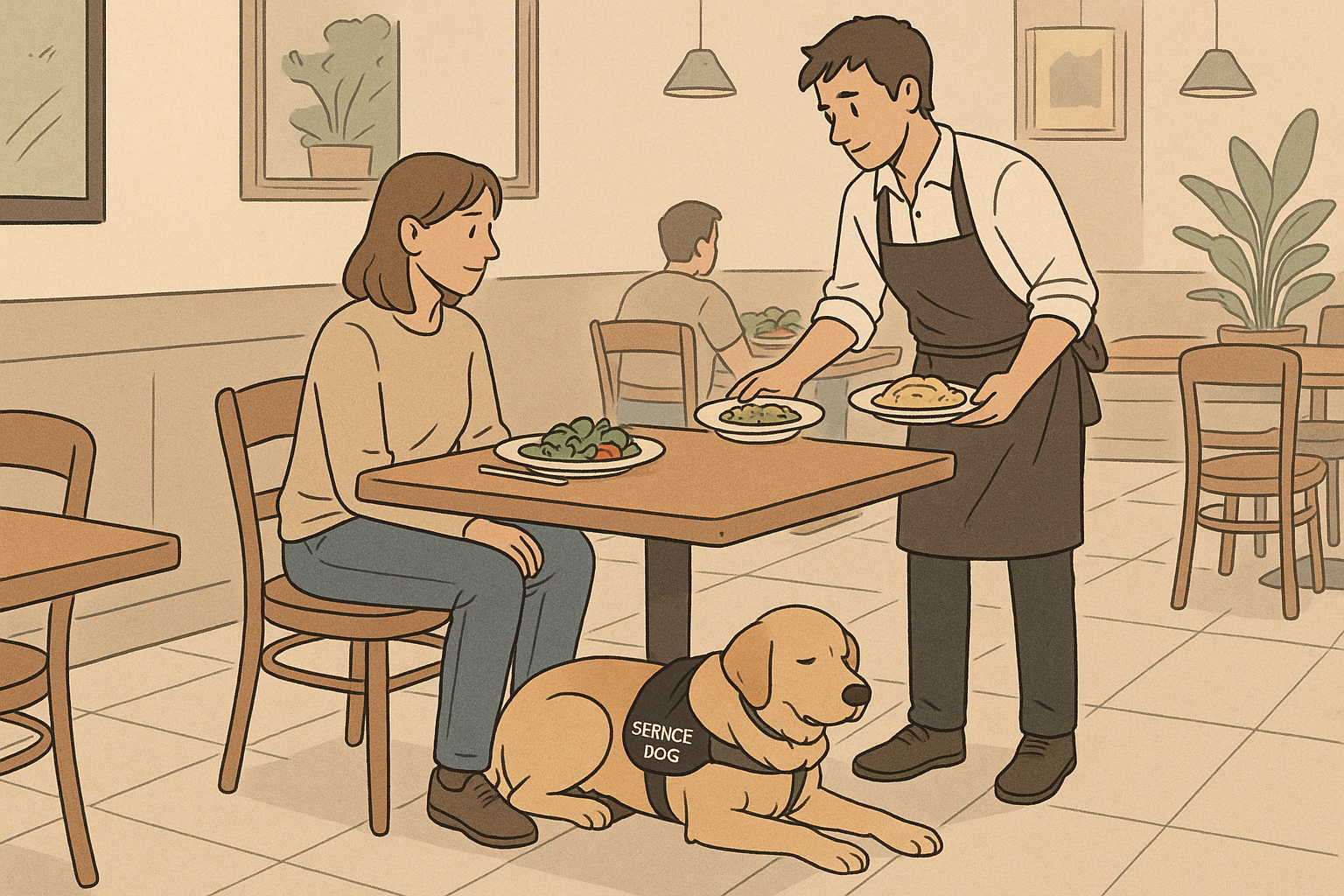
Restaurants: A service dog can accompany the handler into the dining area. Staff should not isolate the customer or treat them like a special case.
Hotels: You can’t add a pet deposit just because the guest has a service dog. (As with any guest, you may charge for actual damage if it occurs.)
Rideshares: If your service is offered to the public, service animals must be accommodated. A driver can’t refuse solely because of the dog.
Retail stores: “No pets” signs don’t apply to service dogs. The handler shops like any other customer.
Businesses do have limited rights to remove a service dog—but the reasons are specific and behavior-based.
A service dog may be asked to leave only if:
• The dog is out of control and the handler doesn’t take effective action to control it, or
• The dog is not housebroken
If removal is necessary, the ADA conceptually focuses on access: you should still offer the person the opportunity to get your goods or services without the dog when possible. In other words, removal of the animal is not the same as refusing service to the person.
A practical example: if a dog is repeatedly barking in a hotel lobby and the handler can’t stop it, staff may ask that the dog be removed. But the guest should still be allowed to check in and stay, if they can do so without the dog present in that moment (and if the situation can be reasonably managed).
Most of the time, “under control” looks like a calm dog staying with the handler, not interfering with others, and responding to cues.
Many service dogs are controlled by a leash, harness, or tether. However, there are situations where that equipment can interfere with the dog’s tasks. In those cases, a handler may use voice control, signals, or other effective methods.
From a staff perspective, the key is not the exact tool used—it’s the result. Is the dog behaving appropriately in the space?
Examples that may indicate a dog is out of control:
• Repeated barking that isn’t a trained alert and isn’t stopped
• Lunging at customers or employees
• Running around the premises
• Jumping on people or knocking into displays
Examples of normal working-dog behavior:
• The dog briefly sniffs the air while walking (without disrupting others)
• The dog repositions to stay tucked under a table
• The dog focuses intently on the handler during crowded foot traffic
If a concern comes up, staff should calmly address the behavior and give the handler a chance to correct it. Escalation usually makes things worse; clarity and consistency make things better.
“ "The best de-escalation tool is a neutral tone. We talk about behavior, not labels." – Customer experience trainer”
Service dogs are still dogs, and generally applicable local requirements can still apply—like vaccination and licensing rules that apply to all dogs in your jurisdiction.
Where businesses get into trouble is when they create special hurdles only for service dog teams, or when they apply blanket restrictions that aren’t based on the individual animal’s behavior.
If your business has safety policies, apply them consistently and evaluate situations case-by-case. The key concept is that a “direct threat” should be based on specific, current behavior—not on stereotypes, fear, or assumptions.
For example, refusing entry because of a breed label alone is not a behavior-based decision. But addressing a dog that is actively snapping, lunging, or causing safety issues is a behavior-based response.
Some handlers use more than one service dog. One dog might perform mobility-related tasks, while another provides medical alerts, for example. When that happens, businesses should accommodate the team when feasible.
That said, space is real. Small exam rooms, narrow aisles, and tightly packed seating can create legitimate constraints. If your team can’t reasonably fit two dogs safely in a particular spot, focus on problem-solving rather than refusal.
Practical steps for tight spaces:
• Offer an end-cap table, corner seat, or wider aisle route
• Ask (don’t demand) whether the handler has a preferred way to position the dogs
• If only one dog can safely remain in a tiny area, work with the handler on an alternative arrangement that still preserves access to the service
The tone matters. “We can’t accommodate you” closes doors. “Let’s find the safest spot that works for you” opens them.

One of the biggest misunderstandings is the idea that service dogs must be professionally trained. Under the ADA framework, professional training is not required. Many handlers train their own dogs.
Another common point of confusion: service dogs in training. The ADA does not treat “dogs in training” the same way it treats fully trained service dogs. However, some state laws do provide additional rights for service animals in training. If you operate in multiple states, it’s worth having a simple internal policy and training note that recognizes this difference.
In day-to-day operations, the cleanest approach is to stick to what you can observe and what you’re allowed to ask. If a dog is behaving appropriately and the handler can answer the two questions, interactions tend to stay smooth.
A policy is only as good as the moment someone has to use it at the door. The easiest way to protect your business and serve customers well is to train staff on a short script, clear do’s and don’ts, and simple incident documentation that focuses on behavior.
Suggested quick script for greeters/hosts/security:
• “Welcome in.”
• (If not obvious) “Just to confirm, is your dog required because of a disability, and what task is it trained to perform?”
• “Thank you—right this way.”
If behavior becomes an issue:
• “I’m sorry—your dog is barking and disrupting the area. Can you get them under control?”
• “If the behavior continues, we may need to ask that the dog be removed, but we can still help you without the dog present.”
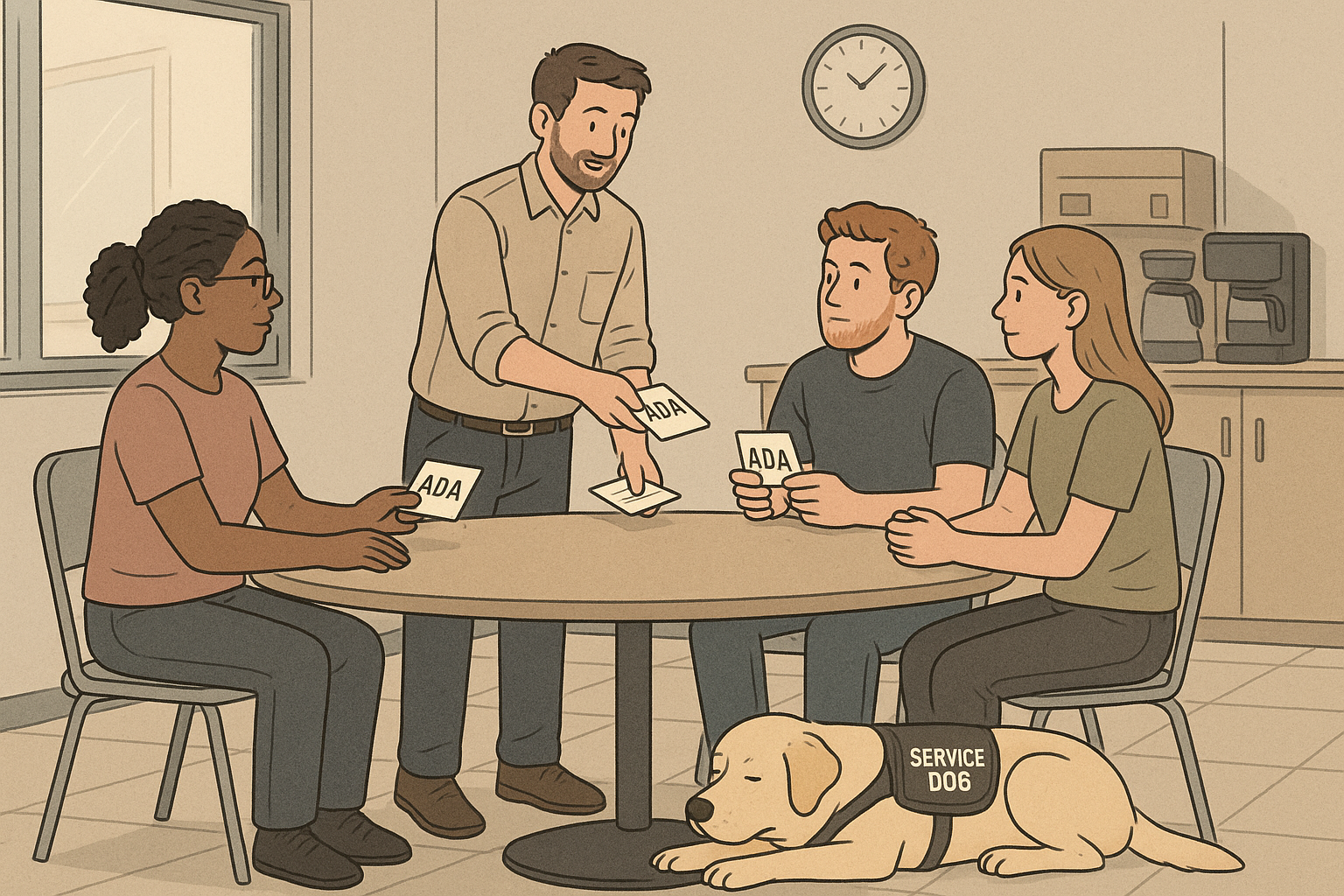
To make training even easier, many businesses keep a short ADA refresher at the front desk or in onboarding materials. Consider equipping your team with ADA service dog law handout cards for staff so everyone knows the same two questions and the same boundaries.
While this article is written for businesses, smooth interactions are a two-way street. Handlers often find that a little preparation reduces stress—especially when traveling, where policies are frequently misunderstood.
Helpful tips many handlers use:
• Answer the two ADA questions succinctly (one sentence each is often enough)
• In crowded areas, proactively position your dog close to you to avoid foot traffic problems
• Stay calm when staff seem unsure—many people have never been trained on the ADA rules
• Plan for tight spaces (restaurants, small lobbies, busy store aisles) and have a “tuck” routine if that’s part of your dog’s working behavior
If you’re planning a trip and want additional guidance, see our resource on traveling with a service dog. Some handlers also prefer to carry easy-to-show materials for smoother conversations during travel; our service dog travel package is designed for confident travel experiences and quick, calm communication.
“ "I’ve found that a clear, calm answer to the two questions prevents most misunderstandings before they start." – Service dog handler”
No. Under the ADA framework, staff should not require an ID card, vest, badge, or paperwork as a condition of entry. If the dog’s status isn’t obvious, use the two permitted questions instead.
In general, no. You shouldn’t isolate or separate a customer just because they have a service dog. You can offer options (like a corner table) if the customer prefers it, but it shouldn’t be a requirement.
Allergies and fear are common concerns, but they don’t cancel access for a service dog team. When possible, use practical solutions like spacing, alternative seating, or adjusting staff assignments—without excluding the handler.
Acknowledge the complaint respectfully and reaffirm that service animals are permitted. Offer the complaining customer reasonable alternatives (different seating, a bit more space), rather than penalizing the service dog handler.
In limited situations, miniature horses may be considered. Accommodation depends on whether the facility can reasonably handle the horse’s size, weight, and whether it can be controlled and is housebroken.
Your trusted source for service animal registration. Get professional ID cards, digital profiles, and smart NFC tags to keep your service animal safe and recognized.
© National Animal Registry — All rights reserved.