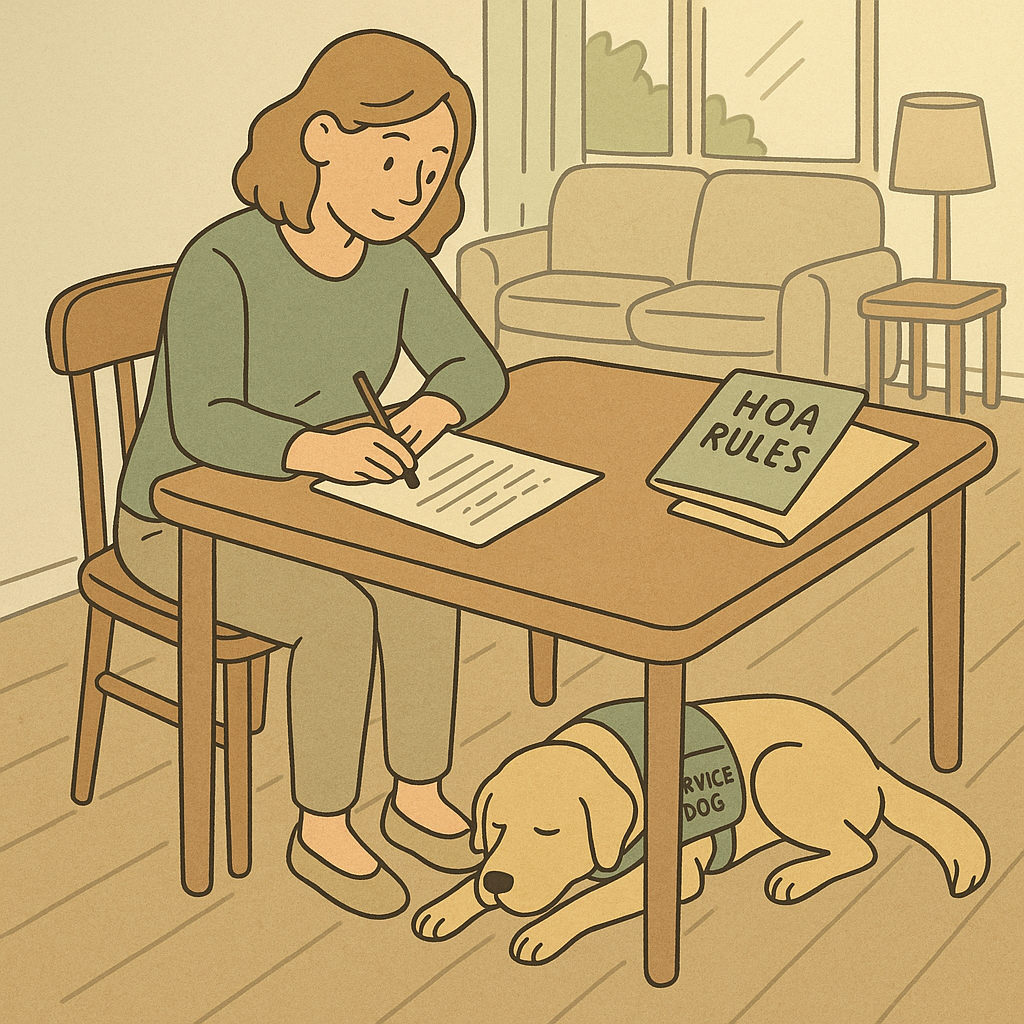
If you live in a community with a homeowners association (HOA), you’ve probably seen strict rules about pets—limits on size, breed, number of animals, or even a flat “no pets” policy. Those rules can feel intimidating when you rely on a service dog or an emotional support animal (ESA). But here’s the reality: in housing, legitimate assistance animals aren’t treated like ordinary pets.
Most HOA pet restrictions have to yield when a resident with a disability requests a disability-related accommodation for an assistance animal. This isn’t about special treatment or skipping rules for convenience. It’s about access and equal opportunity—so a person can use and enjoy their home in a way that’s comparable to other residents.
The good news is that you don’t need to “win an argument” with your board. In many cases, the process is simply: request a reasonable accommodation, provide appropriate information if your need isn’t obvious, and agree to basic behavior standards. The rest of this guide walks you through the definitions that matter, what an HOA can (and can’t) ask for, money rules, and a step-by-step approach to keep things calm and documented.
“ "Once I framed it as an accommodation request—not a debate about pets—the conversation got much easier." – Condo resident and service dog handler”
People use “service animal,” “support animal,” and “ESA” interchangeably in everyday conversation, but an HOA situation is one place where definitions can really change what rules apply.
A service animal (under the ADA, Americans with Disabilities Act) is typically a dog that is trained to do specific work or perform tasks related to a person’s disability. Examples include guiding someone with low vision, alerting to a medical episode, retrieving items, interrupting harmful behaviors, or providing mobility-related assistance.
An emotional support animal (ESA) is generally considered an “assistance animal” in housing under fair housing guidance. In that context, an assistance animal is an animal that provides assistance, performs tasks, or provides emotional support that alleviates one or more identified symptoms or effects of a disability. ESAs do not require specialized task training, and they can be species other than dogs.
One important nuance: under ADA public-access rules, “comfort alone” (being soothing, calming, or therapeutic just by presence) is not considered a trained task. That doesn’t mean an ESA is “less legitimate.” It means different laws govern different settings—and housing is often where ESAs are specifically protected through the reasonable accommodation process.
No. In housing, an ESA is commonly recognized as an assistance animal based on disability-related need, even without specialized task training.
Comfort by presence alone isn’t considered a trained task for ADA public-access purposes. In housing, emotional support can still be a disability-related need that supports an accommodation request.
One of the most confusing parts of HOA living is that the same physical space can feel “public,” but legally function as housing. In practice, two major rule sets often come into play:
Housing rules are generally tied to fair housing concepts and reasonable accommodations. That’s the framework HOAs typically deal with when a resident requests a service dog or ESA so they can live in and use their home.
Public-access rules are tied to public accommodations and generally focus on access for service animals (not ESAs). These rules are more likely to apply when a space is truly open to the public.
HOA-specific examples can help clarify the split:
If a hallway, elevator, lobby, or courtyard is part of the residential community’s common area used by residents and their guests, it’s usually connected to housing use and enjoyment. Requests for an assistance animal in these spaces are commonly handled as a housing accommodation issue.
If an HOA clubhouse hosts public events open to non-residents, or a community facility is rented out in a way that functions like a public venue, a different analysis may apply. The big takeaway is that “where you are” and “why you’re there” can affect which rules are relevant, and it’s smart to focus your request on your housing-related need first.
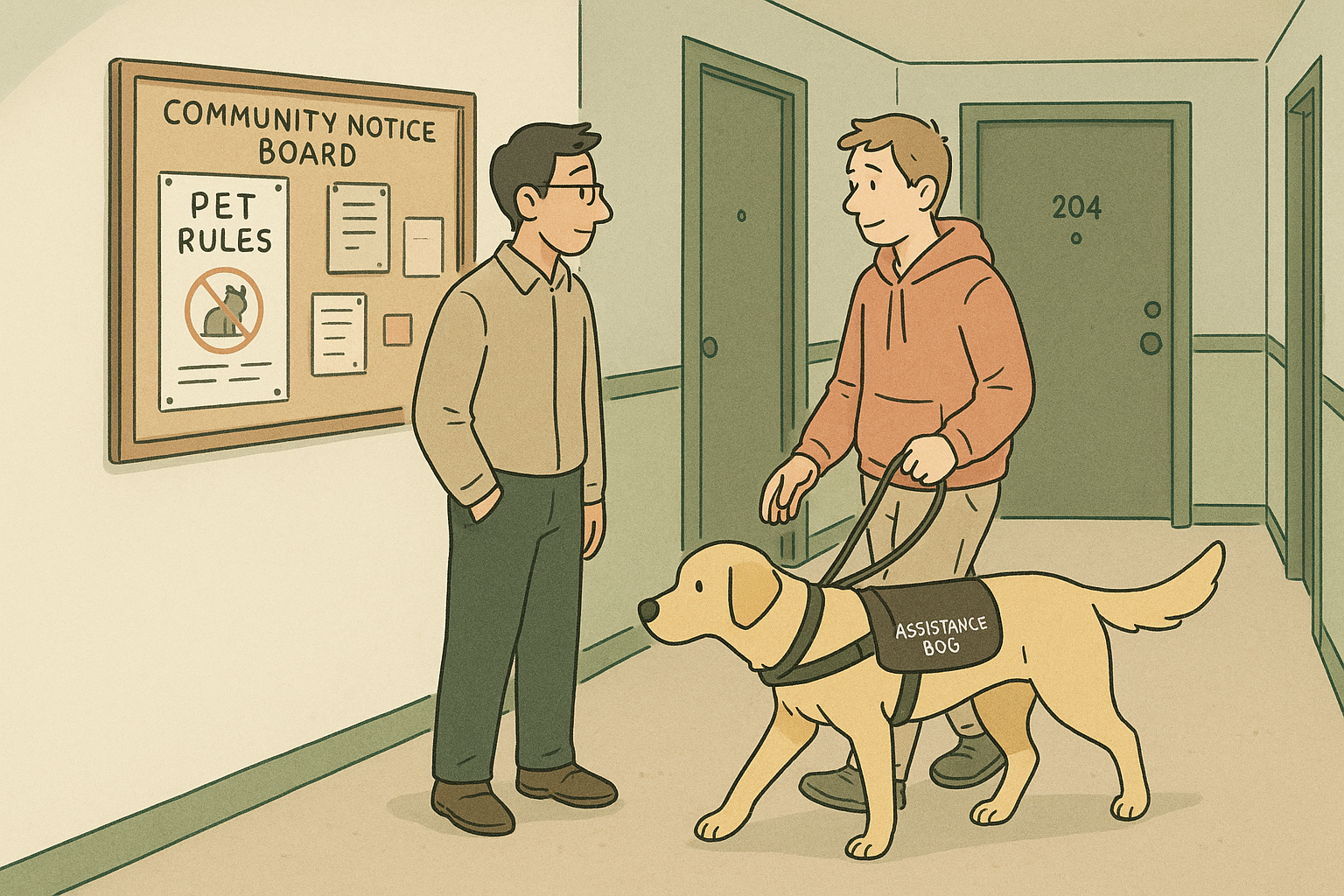
If you remember only one phrase for navigating an HOA with a service dog or ESA, make it this: reasonable accommodation.
In plain language, a reasonable accommodation is an adjustment to a rule, policy, or practice that helps a person with a disability have equal opportunity to use and enjoy a dwelling. In an HOA setting, that often means making an exception to a “no pets” rule, a one-animal limit, a size restriction, or a breed rule—because your animal isn’t being requested as a pet. It’s being requested as an assistance animal connected to a disability-related need.
HOAs are expected to consider these requests instead of automatically defaulting to the pet policy. That consideration process is a big deal: it’s where misunderstandings can be prevented and where both sides can work out practical details (routes for potty breaks, where records are stored, how to handle community concerns) without turning it into conflict.
HUD’s assistance animal guidance is a helpful reference point for understanding how housing providers evaluate these requests and why pet restrictions often can’t be applied the same way to legitimate assistance animals (source).
“ "A reasonable accommodation is usually about removing a barrier, not proving you deserve an exception." – Housing advocate”
Most HOA conflicts don’t happen because anyone is trying to be cruel—they happen because people don’t know what information is appropriate to request or share.
In general, your HOA can ask for a written request (and it’s usually better for everyone if you provide one). If your disability and/or disability-related need for the animal isn’t obvious, the HOA can ask for reliable documentation that supports two basic points: (1) that you have a disability, and (2) that you have a disability-related need for the animal.
At the same time, there are lines HOAs shouldn’t cross. Boards and managers generally should not demand intrusive medical records, require you to disclose diagnosis details, or insist on mandatory registrations/certifications as a condition of consideration. And an HOA typically can’t deny a legitimate request by simply pointing to a blanket “no pets” rule.
When in doubt, aim for a calm exchange of “minimum necessary” information—enough to support the request without turning your private health information into a neighborhood discussion.
HOAs typically should not demand diagnosis details. If your disability-related need isn’t obvious, they may request reliable documentation confirming disability and the disability-related need for the animal, without intrusive specifics.
An HOA generally should not make approval contingent on mandatory certifications/registrations. The focus is on disability-related need and reasonable accommodation, not a paperwork “membership.”
This is where many residents get blindsided: an HOA might say, “Fine, but you still have to pay the pet deposit,” or “You can have the dog if you pay the monthly pet fee.” In housing accommodation situations, assistance animals are not treated like typical pets for fee purposes, and pet rent/pet deposits generally can’t be tacked on just because an animal is involved.
However, that does not mean “no responsibility.” Residents can still be held responsible for actual damage caused by the animal.
Practical examples:
Damage might include chewing a door frame, scratching floors beyond normal wear, staining carpet, or repeated urine damage to common-area landscaping.
Normal wear is the kind of routine aging a unit or common area experiences over time—minor scuffs or ordinary use that would happen regardless of an animal.
Many HOAs document damage the same way they would for any resident-caused property issue: photos, written notices, repair invoices, and an opportunity to correct the problem. If you want to reduce anxiety on all sides, it can help to proactively tell the HOA you understand you’re responsible for damage and that you’ll follow community cleanliness standards.
“ "We didn’t pay a pet fee for our assistance animal, but we were careful to document training, grooming, and cleanup so there was never a question about damage." – HOA resident”
An accommodation is not the same thing as a free-for-all. HOAs can typically enforce neutral, nondiscriminatory rules that relate to health and safety—so long as they’re applied fairly and don’t single out disability-related animals.
That usually means expectations like:
Leash policies (as long as they’re consistent with disability needs and applied neutrally). If a leash interferes with a handler’s disability-related use in a specific situation, a practical alternative might be appropriate.
Waste cleanup rules for all animals in common areas.
Reasonable noise standards. Occasional barking happens; persistent, disruptive noise may need to be addressed.
Basic safety rules, including control of the animal and respectful conduct around neighbors.
One of the simplest conflict-prevention tools is to address behavior expectations up front: “My dog will be leashed in common areas; I’ll use the designated waste station; I’ll address barking issues quickly.” That framing reassures boards and neighbors that the accommodation won’t become a community-wide problem.
It can be reassuring to know that HOAs aren’t powerless—and it can also protect you to know the limits are narrow. Denials (or restrictions) should not be based on stereotypes, fear, or assumptions about certain breeds or the idea that “we’ve always had a no-pets rule.” Decisions should be grounded in objective, specific facts.
Generally, an HOA may be able to deny a request or require adjustments if:
There is no disability-related need for the animal (for example, documentation doesn’t support the connection, or the request is essentially for a pet).
The animal poses a direct threat to the health or safety of others that can’t be reduced or eliminated by another reasonable accommodation.
There is a substantial risk of significant property damage that can’t be reduced or eliminated by another reasonable accommodation.
Granting the request would create an undue administrative/financial burden or fundamentally alter operations (this is typically rare in the assistance-animal context).
If your HOA raises a concern, it’s often worth responding with solutions instead of defensiveness: a behavior plan, a different route for entering/exiting, extra cleanup measures, or a temporary restriction that allows time for the issue to be resolved.
Blanket breed/weight bans are often problematic when used to deny an assistance-animal request without individualized, objective evidence. HOAs generally need to evaluate the specific animal and situation.
Fear alone usually isn’t a sufficient reason to deny a legitimate accommodation. Practical solutions (leash use, distance in hallways, controlled entry/exit) often address concerns without restricting rights.
A well-structured request can turn a stressful situation into a straightforward administrative process. Here’s a practical sequence you can follow.
Start by reviewing your HOA’s governing documents (CC&Rs, rules, and any published policies on animals). This helps you reference the right contact person and submission method.
Next, write a concise reasonable accommodation request. Keep it calm, direct, and focused on the rule exception you need. You can describe the animal (species, approximate size, and basic behavior expectations), and state that the animal is needed because of a disability-related reason—without sharing diagnosis details.
If your disability and need aren’t obvious, attach reliable documentation. Your goal is to support the request, not to overshare your personal history.
Ask for a response within a reasonable time, and keep copies of everything: your request, attachments, emails, letters, and any meeting notes. If you speak by phone or in person, follow up with a short email summarizing what was said.
A simple script you can adapt:
What to say: “I’m requesting a reasonable accommodation to keep an assistance animal in my unit despite the pet restriction. The animal is needed for a disability-related reason. Please let me know if you need any additional information to evaluate the request.”
What not to overshare: detailed medical history, diagnosis specifics, or more personal information than needed to establish the disability-related need.
“ "I kept my letter to one page. Clear request, clear need, calm tone. That made it easier for the board to say yes." – ESA owner in a condo community”
When documentation is appropriate, think “reliable and minimal.” A strong letter is typically written by a licensed provider and confirms what the HOA needs to evaluate the request—without turning into a full medical disclosure.
In general, a helpful letter:
Identifies the provider as licensed (and ideally includes contact information).
Confirms that you have a disability (without listing diagnosis details).
Confirms that you have a disability-related need for the animal (how the animal helps alleviate symptoms or effects).
Keeps the content focused and nonintrusive.
A common pitfall is relying on generic online letters that don’t reflect a genuine provider relationship. Housing agencies have cautioned against documentation that looks “cookie-cutter” or detached from real care, because it can create disputes and delays.
If an HOA challenges your documentation, don’t panic. Ask—politely and in writing—what specific element they believe is missing (for example, disability confirmation, disability-related need confirmation, or provider credentials). Then provide a clarifying note from the provider, rather than escalating the amount of private medical information you share.
Usually, no. The goal is to confirm disability and disability-related need with minimal, nonintrusive information—enough to evaluate the accommodation without exposing private medical details.
You can ask what information they need and whether they have a preferred format, but the substance matters more than a specific form. A brief clarifying note from a licensed provider often resolves format objections.
If you get pushback, your best tools are calm communication and a clean paper trail. Start by responding in writing, even if the initial refusal came via a hallway conversation or a phone call.
Ask the HOA to clarify its position: “Can you tell me specifically what information is missing to evaluate my accommodation request?” This keeps the discussion focused on process rather than opinions.
If appropriate, share official guidance (without turning your email into a legal threat). You can also propose practical solutions tailored to the concerns raised, such as:
A plan for additional waste cleanup or the exact route you’ll use to reach outdoor areas.
A training/behavior plan if noise or reactivity is raised as an issue.
Safety tools if relevant to the animal and situation (for example, extra distance in elevators, or a muzzle plan if there is a demonstrated and legitimate concern and it doesn’t interfere with the animal’s role).
If the HOA continues to refuse, delays indefinitely, or imposes unlawful conditions, you can consider filing a complaint with the appropriate housing authority (HUD or a state/local fair housing agency). In more complex situations—especially if deadlines are looming or you face fines—consulting an attorney may be the fastest way to protect your housing stability.
Whatever you do, keep records: dates, who said what, copies of letters, and any rule enforcement actions. Clear documentation often prevents a misunderstanding from turning into a long-term dispute.
“ "The moment I started documenting everything politely—dates, emails, what was requested—the process shifted from emotional to procedural." – HOA resident”
If you’re sharing this with an HOA board or property manager, the goal is a smooth, consistent process that respects residents and reduces liability. Assistance-animal requests are usually handled as disability-related reasonable accommodation requests in housing.
Boards should be prepared to consider requests even when pet policies are strict, avoid intrusive information demands, and apply neutral behavior rules consistently. Residents, in turn, should submit a clear written request, provide reliable documentation when needed, and follow cleanliness and control expectations.
When both sides stay focused on objective facts and practical solutions, these situations are often resolved quickly—and everyone gets to move on with daily life.
Use a consistent written process: accept accommodation requests, ask only for limited reliable documentation when needed, respond within a reasonable time, and enforce the same neutral behavior rules for all residents.
Make the request in writing, share only the necessary information, and proactively commit to control, cleanup, and noise expectations in common areas.
Your trusted source for service animal registration. Get professional ID cards, digital profiles, and smart NFC tags to keep your service animal safe and recognized.
© National Animal Registry — All rights reserved.